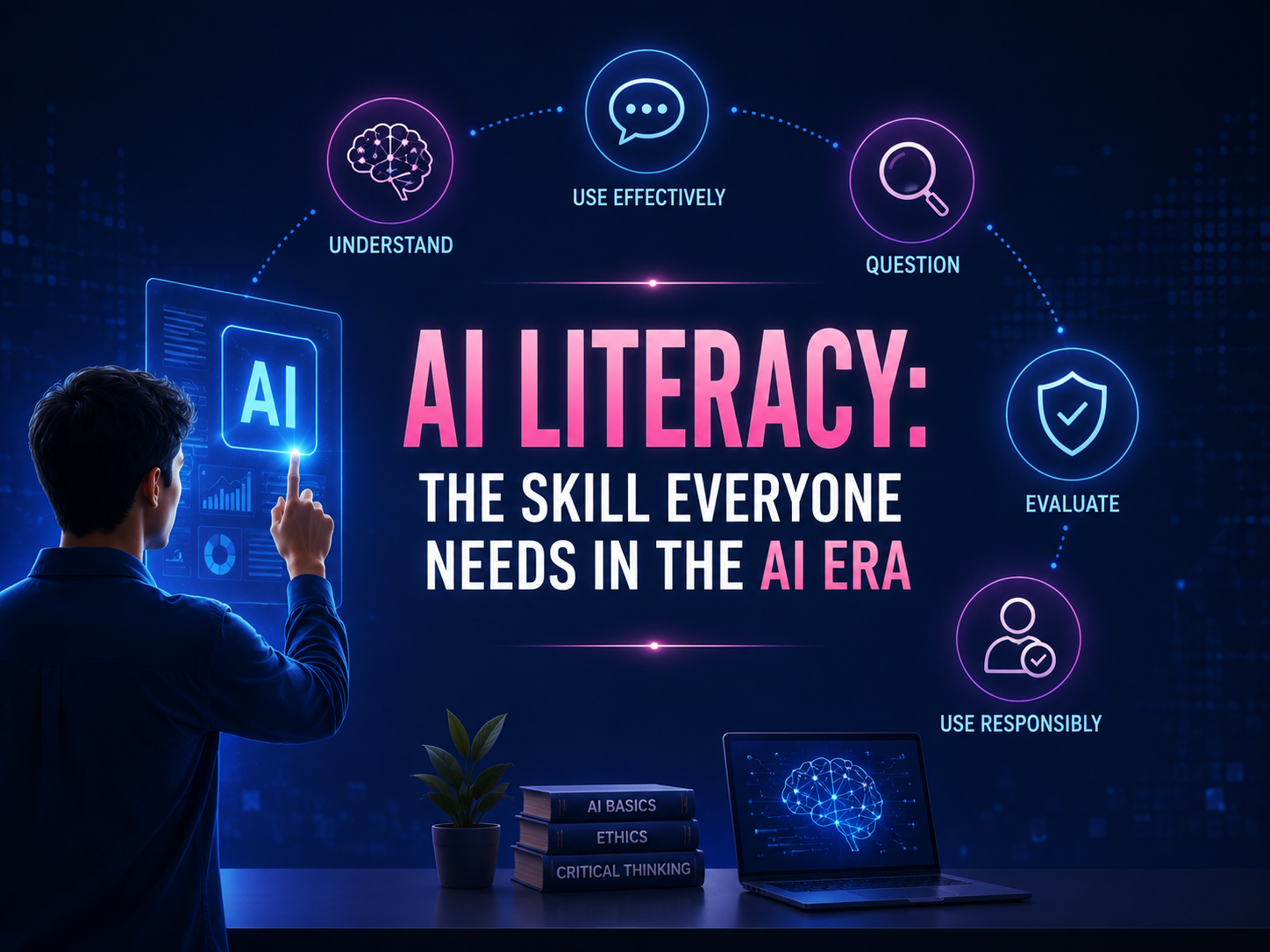
AI is no longer limited to research labs or tech firms. People are already using it to write, learn, search, create, analyze and make decisions. However, using AI is one thing, understanding it is quite another. AI literacy can help with that.
Table of Contents
What is AI Literacy?
The capacity to understand, use, assess and engage with artificial intelligence in an efficient and responsible manner is known as AI literacy.
Neural network construction and advanced machine learning code writing are not required. Rather, AI literacy provides you with sufficient knowledge to fully understand what AI can achieve, where it can fail and how to use it properly.
It blends practical skills, critical thinking, responsible use and fundamental AI understanding. In simple language, AI literacy is the ability to use AI without relying only on it.
Why is AI Literacy Matter?
AI is starting to invade daily life. It can be found in a variety of settings, including search engines, recommendation engines, customer service, education, workplaces and creative tools.
People may either reject helpful technology or have too much faith in it if they lack AI literacy. Asking better questions, identifying inaccurate outputs, protecting sensitive data and determining when AI should or shouldn’t be applied are all made easier for someone who is AI literate.
Being an expert in AI is becoming less important than being a knowledgeable IT user.
What Does AI Literacy Include?
Understanding Basic Concepts
Understanding basic concepts like artificial intelligence, machine learning, generative AI, training data, algorithms and large language models is the first step in becoming AI literate.
Understanding every technical aspect is not the aim. The goal is to create a conceptual model of how AI systems typically operate and the reasons why their results could differ.
Effective Use of AI
It is insufficient to know that an AI tool is available. Additionally, users must understand how to effectively engage with it. This may consist of:
- Writing clear prompts
- Providing useful context
- Giving examples when necessary
- Refining responses
- Choosing the right AI tool for a task
- Reviewing the final output instead of accepting it immediately
Therefore, using AI effectively involves more than just asking it a question. It is the ability to direct, assess and improve the results.
Evaluating AI Outputs
Knowing that AI can make mistakes is one of the most crucial aspects of AI literacy. AI systems have the potential to generate biased results, out-of-date data, incorrect data or compelling claims with no solid foundation.
Therefore, before acting on AI-generated information, AI-literate users challenge significant outputs, check facts, compare sources and apply human judgement.
Identifying Dangers and Accountability
Understanding the dangers of AI is another aspect of AI literacy. Users should be aware of things like:
- Privacy and sensitive data
- Bias and fairness
- Copyright and ownership
- Misinformation
- Security risks
- Overdependence on AI
- Responsible use of AI-generated content
The intention is not to be afraid of AI. It is to use it mindfully.
AI Literacy in Everyday Life
You might not even be aware of how frequently you already interact with AI.
AI can be used in a variety of applications, such as a streaming service that suggests a movie, a navigation app that predicts traffic, an email service that filters spam or an AI assistant that assists you with summarizing information.
AI literacy enables you to go beyond simply using these tools to understand how they influence your choices. An AI-literate individual might, for example, ask as to why an AI recommendation was made rather than just following it. What facts could have affected it? Is there another choice?
That tiny change, from acceptance to assessment has significant impact.
AI Literacy vs AI Expertise
AI literacy does not mean becoming an AI engineer.
Mathematics, programming, statistics, machine learning and specific technical knowledge may be necessary for AI expertise. The audience for AI literacy is far wider. AI literacy can help anyone using AI tools, including students, teachers, writers, designers and business professionals.
Consider it similar to driving, you can learn how to drive a car safely without having to build one.
How to Build AI Literacy?
- Learn the Basics: Gain an understanding of core AI terms and ideas.
- Try out AI Tools: Using them for routine activities and seeing how they react.
- Examine the Results: Consider AI responses as data to be assessed rather than as absolute truths.
- Verify Important Information: Check crucial facts, particularly before making judgements that depend on accuracy.
- Learn Responsible Behavior: Get an understanding of copyright, privacy, bias and ethical issues.
- Continue Learning: AI literacy is a continuous talent rather than a one-time accomplishment because AI is evolving rapidly.
Future of AI Literacy
Understanding AI will become more and more important as it is incorporated into everyday technologies, companies and education.
Those with the most technical knowledge might not always be the ones that gain the most. They might be the ones who understand when to employ AI, how to use it, when to challenge it and when human judgement is more important.
In the end, AI literacy is more than just improving one’s ability to use AI tools, it’s about being a more intelligent participant in a world driven by AI.
Conclusion
AI literacy is rapidly emerging as a useful ability for modern life. It enables people to use AI with greater skill while acknowledging its limitations, dangers and obligations. The future might belong to those who know how to use AI responsibly rather than those who just use it.
FAQs
Q.1 What is AI Literacy?
The ability to understand, use, assess and engage with artificial intelligence in an efficient and responsible manner is known as AI literacy.
Q.2 Do professionals and students need to be AI literate?
Certainly. Professionals and students can use AI tools more efficiently, assess information critically, and adjust to workplaces where AI is being used more frequently with the help of AI literacy.
Q.3 Does learning AI literacy require programming skills?
No, extensive programming skills or technical expertise are not necessary for AI literacy. By studying fundamental AI principles and using AI tools, beginners can build it.
Q.4 Will employment in the future require AI literacy?
As more companies integrate AI into daily operations, the value of AI literacy is expected to rise. People can adjust to shifting employment requirements by learning how to collaborate with AI.