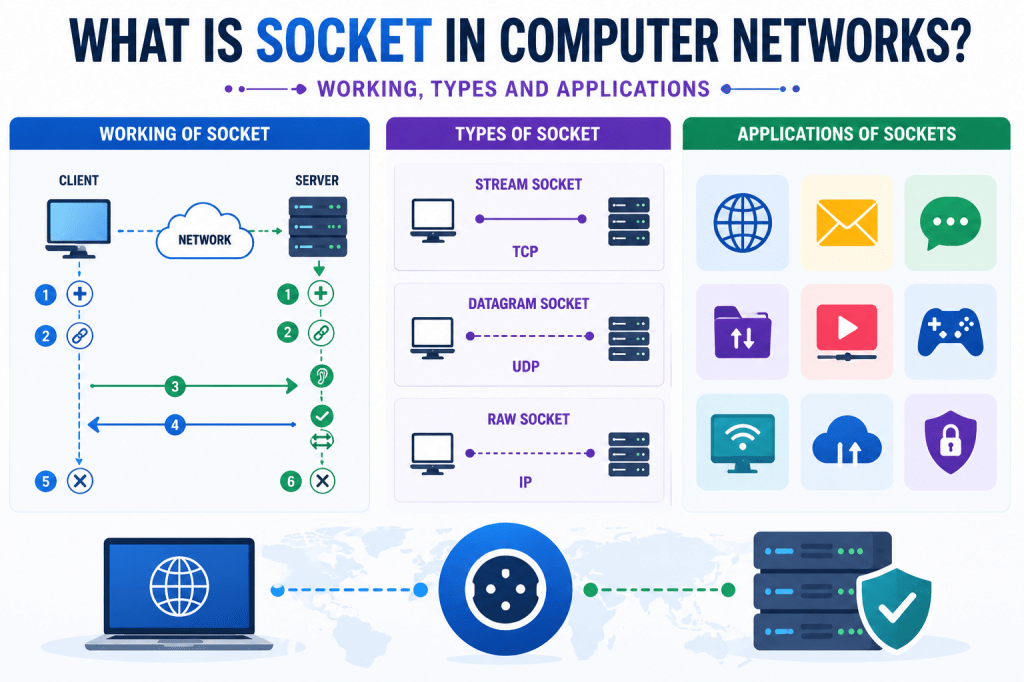
One endpoint of a two-way communication channel between two networked programs is called a socket. By the development of named contact points, the socket mechanism allows inter-process communication (IPC).
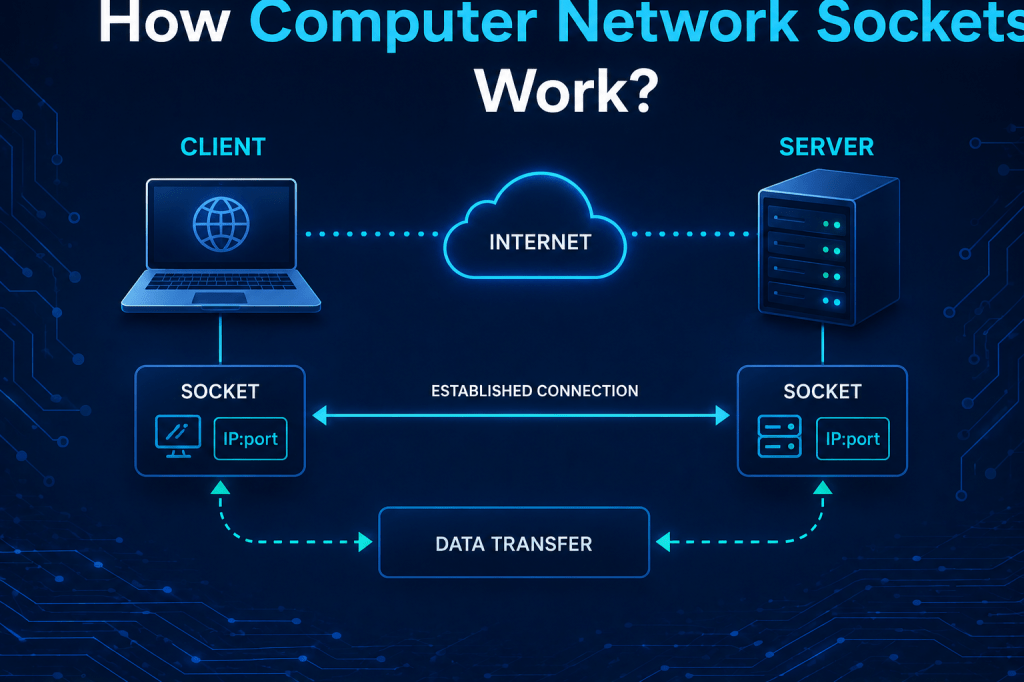
How Computer Network Sockets Work?
Pipes are constructed using the ‘Pipe’ system call, and sockets are created using the ‘socket’ system function. Bidirectional FIFO network communication is made possible by the socket.
At both ends of the communication, a socket is constructed that connects to the network and every socket has a unique address. An IP address plus a port number make up this address.
In client-server applications, sockets are basically used. Then the server waits for the client to reach it after creating a socket. It attaches it to a network port address. After the socket is created, the client tries to establish a connection with the server socket and then data is transferred after the link is made.
Types of Sockets
- Datagram Socket: This kind of network uses a connection-less point to send and receive packets. It mimics a mailbox. After being posted into the box, the letters (data) are gathered and sent to a letterbox (receiving socket).
- Stream Socket: In computer operating systems, a stream socket is a type of network socket that offers a connection-oriented, sequential, and distinct data flow without record boundaries with clearly defined mechanisms for establishing and terminating connections and error detection. It is identical to a phone. The phones (two ends) establish a connection, and a dialogue (data transfer) occurs.
- Raw Socket: Without utilizing common transport layer protocols like TCP or UDP, a raw socket enables direct connection with network layer protocols. Network testing and sophisticated networking jobs are its primary uses.
- Sequenced Packet Socket: While maintaining packet boundaries, a Sequenced Packet Socket enables connection-oriented communication. It guarantees the sequential delivery of packets. It is a secure means of communication and preserves message boundaries.
Most Common Function Calls
- Socket(): To establish a socket
- Bind(): This is a socket identity that functions similarly to a phone number.
- Listen(): Prepared to accept a connection
- Connect(): Prepared to send
- Read(): To obtain information
- Close(): To terminate a connection
- Accept(): Confirmation is similar to agreeing to take a call from a sender.
- Write(): To transmit information
Applications
- Online Chat Applications: Sockets are used in messaging applications to allow users to communicate in real time.
- Distributed Systems: Sockets allow effective communication between several devices and servers in distributed systems and networked applications.
- Internet Browsing: Sockets are used in web servers and browsers to send data and web pages over the internet using protocols like HTTP and HTTPS.
- Playing Video Games Online: Sockets are used in multiplayer online games so that players and gaming servers can share real-time game data.
- Transfer of Files: Applications and protocols such as FTP use sockets to upload and download files across systems.
Conclusion
In order to promote communication between devices and applications over a network, computer network sockets are a crucial component of modern networking. They make network communication quicker, more dependable and scalable by offering an effective and structured way to share data. As sockets are the basis of many communication technologies used in today’s digital world, understanding them is crucial for networking experts, developers and students.
FAQs
- What is a socket in computer networks?
A socket in computer networks is an endpoint which uses an IP address and port number. This is to provide communication between two devices or applications through network.
- What is the difference between UDP sockets and TCP sockets?
UDP sockets offer quicker but connection-less communication but TCP sockets offer dependable and connection-oriented communication.
- Which computer programming languages are compatible with socket programming?
Socket programming is supported by widely used programming languages like C, C++, Java, Python, and JavaScript.
- What is a port number in a socket communication?
Sockets use port numbers, which are distinct identifiers, to route data to the appropriate application or function on a device.
 The Prism Nova