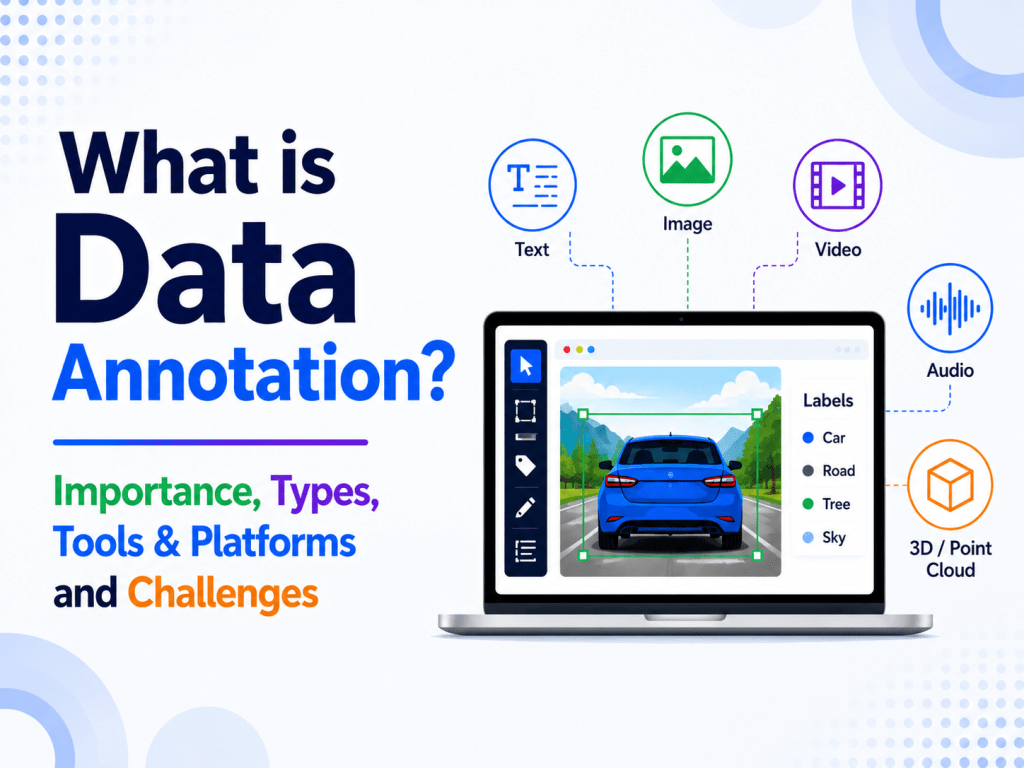
Data is important to train intelligent systems in the current time of artificial intelligence (AI) and machine learning (ML). However, machines cannot successfully understand patterns, objects, sounds, or language from raw data alone. This is where data annotation comes into play, since it helps AI models in meaningfully labelling and organizing data. Data annotation helps in the creation of precise and effective AI applications, from chatbots and system recommendations to self-driving cars and medical imaging. Somebody interested in AI technology and data-driven systems have to understand data annotation.
What is Data Annotation?
Data Annotation is the process of annotating raw data with relevant details or metadata to make it understandable and useful for machine learning algorithms. This metadata can contain a wide range of information like categories, tags, annotations and other descriptors. This provides context or meaning to the data. Data points can be given context, structure or significance by annotating or labelling them. Data Annotations work as the foundation for training machine learning algorithms to identify patterns, generate predictions and extract insights.
Importance of Data Annotation
- Ensuring Accuracy and Quality: Training accurate and dependable machine learning models requires high-quality annotations. Data annotation ensures the correctness and quality of training data which directly affects the model’s performance by offering precise and consistent annotations.
- Supporting Domain-Specific Tasks: Depending on the problem area, different machine-learning tasks require for different kinds of annotations. Data annotation gives training models the context and structure they need to succeed in tasks like the detection of an object, sentiment analysis and medical diagnosis.
- Enabling Supervised Learning: One of the most popular machine learning techniques, supervised learning uses tagged data for training. By offering foundational labels that direct the learning process and assist in the model’s extension to previously unseen data, data annotation facilitates supervised learning.
- Minimizes AI System Errors: The probability of inaccurate forecasts and system failures is reduced by high-quality data annotation. Accurate labelling ensures AI models to produce more dependable and trustworthy results.
- Increases Natural Language Processing (NLP): NLP algorithms are more capable of understanding grammar, sentiment, context, and human purpose with the use of annotated text data. Applications such as voice assistants, sentiment analysis systems, and translation tools function better as an outcome.
Types of Data Annotation
- Text Annotation: Text annotation involves labelling words, phrases, or sentences inside textual data. This is to assist machines in analyzing language and context. Chatbots, sentiment analysis, the identification of spam and language translation systems all frequently use it.
- Image Annotation: The practice of labelling features, borders, or objects inside images is known as image annotation. It is extensively utilized in computer vision applications, including driverless cars, medical imaging and facial identification.
- Video Annotation: Labelling moving objects or actions in a movie frame by frame is known as video annotation. AI systems better understand motion, behavior and events across time with the support of this kind of annotation.
- Landmark Annotation: On things, particularly human faces or bodily parts, landmark annotation highlights very important points. Applications involving motion tracking and facial recognition can benefit from it.
- Audio Annotation: Labelling sound recordings, speech, music, or background noise for machine learning applications is known as audio annotation. For voice-based AI systems and speech recognition, it is crucial.
- Polygon Annotation: Polygon annotation creates exact dimensions around irregular objects in photos by utilizing many points. When compared to bounding boxes, it offers more accurate labelling.
- Sentiment Annotation: Text is labelled with sentiment annotation based on its emotional tone, which might be neutral, negative or positive. This annotation is used by businesses to examine consumer comments and opinions.
Best Tools and Platforms for Data Annotation
- Label Studio: Text, photos, audio and video are all supported by the open-source annotation platform Label Studio. It is used for tasks involving machine learning and natural language processing (NLP).
- Encord: Image, video, audio, text and 3D data labelling are all supported by the enterprise-grade annotation platform Encord. It offers Human-in-the-Loop (HITL) features and complex workflow management.
- Labelbox: Labelbox is a well-known cloud-based data annotation tool. It is used for labelling text, audio, video, and images. For corporate AI projects, it offers workflow management tools, collaboration features and AI-assisted labelling.
- CVAT: The primary purpose of CVAT, an open-source annotation tool, is computer vision tasks. With complicated automation capabilities, it facilitates object detection, segmentation, tracking and annotation of images and videos.
- Roboflow: Annotation, dataset management, model training and deployment functions are all included in Roboflow, which is an end-to-end computer vision platform. To simplify annotation tasks, it combines AI-assisted labelling tools.
Common Challenges of Data Annotation
- Excessive Time Consumption: Annotating data takes a lot of time as it works with big datasets that include text, photos, videos and audio. Manual labelling slows down the development of AI models and frequently needs a large amount of human labor.
- Validation and Quality Control: Regular reviews and validation procedures are necessary to guarantee that annotations fulfil quality criteria. Error detection and dataset reliability require regular surveillance.
- Lack of Skilled Annotators: Certain annotation jobs, such labelling medical images or annotating legal texts, call for domain-specific knowledge. It might be challenging and expensive to find qualified experts for specialized datasets.
- Costly Procedure: Hiring qualified annotators, keeping annotation tools up to date and guaranteeing quality control increases operational costs. Corporations may need to invest a good amount of money in large-scale annotation projects.
Conclusion
Data Annotation in artificial intelligence (AI) and machine learning (ML) is an important technique because it enables robots to effectively learn and understand from labelled data. It improves the effectiveness, dependability and efficiency of AI systems used in a variety of sectors, including automation, healthcare, finance and retail. Building reliable and intelligent applications require high-quality annotation despite obstacles like cost and time waste. Data scientists, AI engineers, machine learning developers, scholars and students who deal with AI technologies and data-driven systems should learn about this.
FAQs
- What is Data annotation?
The practice of labelling text, photos, audio and video data to help AI and machine learning models in properly understanding and processing information is known as data annotation.
- Can data annotation be automated?
Machine learning and AI-assisted systems can automate some annotation tasks but to guarantee accuracy and quality, human checking is important.
- Why is data annotation important to AI?
Data Annotation is important as AI models need labelled data to be trained. Model performance, prediction accuracy and decision-making ability are all improved by accurate annotations.
- Which industries use of data annotation?
AI-based applications in industries like healthcare, finance, retail, automotive, cybersecurity and e-commerce use data annotation.
 The Prism Nova