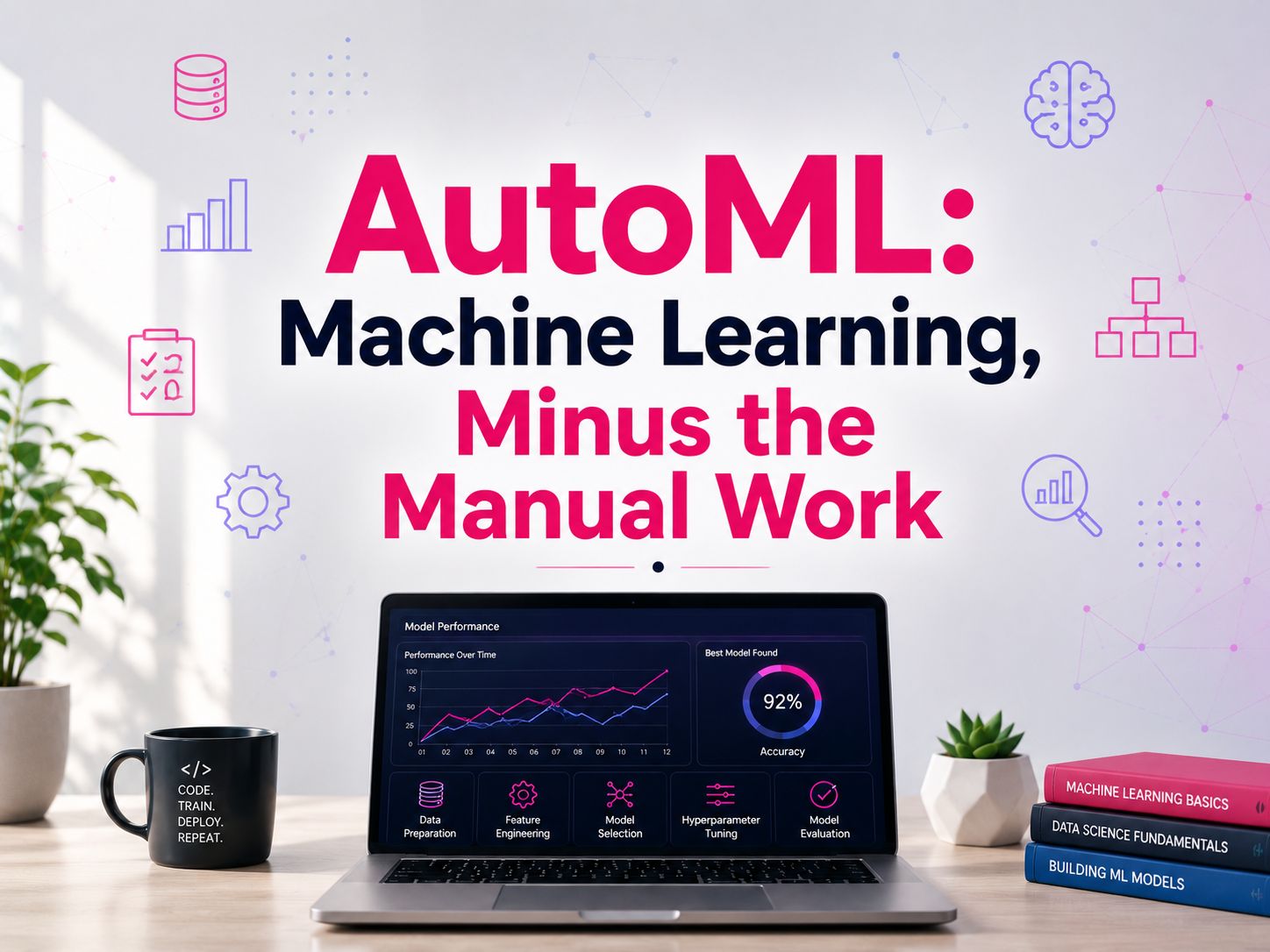
Creating a machine learning model frequently involves a number of processes, including data preparation, algorithm selection and parameter tuning. This procedure can seem difficult and time-consuming to beginners. Many of these activities are made easier by AutoML (Automated Machine Learning), which automates some steps in the machine learning process. It keeps machine learning at the core of the process while enabling users to construct and assess models with minimal human labor.
Table of Contents
What is AutoML?
A collection of methods and resources known as AutoML, or Automated Machine Learning, automate a number of the processes required in creating machine learning models. A data scientist may have to manually clean data, pick features, select an algorithm, modify hyperparameters, train various models and evaluate their performance in traditional machine learning.
Many of these steps can be automated with AutoML. This system can try several strategies and find models that work well on the provided dataset rather than manually testing a large number of alternatives. AutoML does not, however, totally eliminate the need for people. Users still need to specify the issue, supply relevant data, choose appropriate assessment criteria and determine whether the final model makes logic.
Why do we Need AutoML?
It can take a lot of time and experience to construct machine learning models. Finding the ideal features and hyperparameters may need constant testing even after a method has been chosen. This manual labor is reduced with the use of AutoML. It can automatically test various settings and algorithms, speeding up and simplifying the development process.
Beginners who can understand a business problem but lack knowledge with machine learning algorithms and optimization strategies may find this particularly helpful.
How Does AutoML Operate?
To create a machine learning model, an AutoML system typically goes through a number of steps.
- Data Preprocessing
Getting the data ready for machine learning is the first step. AutoML tools can do tasks like recognizing inappropriate data, modifying numerical characteristics, encrypting classification data and handling missing values. Since AutoML cannot suddenly fix datasets that are fundamentally flawed, high-quality data is still crucial.
- Feature Engineering
Features are the pieces of data that a model uses to predict outcomes. AutoML can generate new features from preexisting ones or automatically choose useful features. For example, an AutoML system may find helpful trends like average expenditure or purchase frequency in a dataset that includes a customer’s past purchases.
- Model Selection
For various datasets and issues, different machine learning algorithms perform better. Depending on the job and platform, AutoML may train and compare a variety of methods, including decision trees, linear models, random forests, gradient boosting models and neural networks.
- Hyperparameter Optimization
Hyperparameters are settings that affect how machine learning models learn. For example, a model may have parameters that control the number of estimators, tree depth or learning rate. AutoML may automatically look for combinations that produce better results rather than requiring human verification of these variables.
- Model Evaluation
AutoML uses appropriate metrics to assess the performance of various models once they have been trained. Metrics for a classification challenge could be F1-score, AUC, accuracy, precision or recall. Metrics like mean absolute error and root mean squared error can be applied to regression situations. After comparing the results, an algorithm can find models that show potential.
Benefits of AutoML
- Faster Model Creation: The amount of time needed to experiment with various models and setups can be greatly decreased by automating repetitive processes.
- Reduced Manual Labor: It is not necessary for users to manually test each method or combination of hyperparameters. Much of this experimentation is handled automatically by AutoML.
- Beneficial for Skilled Professionals: AutoML is not just for beginners. To create a more specialized solution, skilled professionals can use it as a starting point, baseline or experimental tool.
- Improved Machine Learning Accessibility: These systems allow people with little machine learning skills to create models without needing to fully understand each algorithm.
Applications of AutoML
- Healthcare: It can assist in the development of models for tasks like patient result prediction, medical picture analysis and disease risk prediction.
- Finance: AutoML can be used by financial institutions for buying patterns prediction, credit risk evaluation and fraud detection.
- Promotion: Machine learning can be used by businesses to predict customer turnover, find new clients and examine how customers behave.
- Retail: Demand estimation, recommendation systems, inventory planning and sales prediction are all supported by AutoML.
- Production: It can be used by producers for quality assurance, maintenance prediction and identifying abnormal machine behavior.
Popular AutoML Tools and Platforms
- H2O AutoML: Model training, comparison and hyperparameter adjustment are all automated with H2O AutoML.
- AutoGluon: It is an open-source AutoML framework intended for multimodal prediction and machine learning.
- Auto-sklearn: Adds automated model selection and optimization to the well-known scikit-learn environment.
- Google Cloud AutoML: Offers managed machine learning features through Google Cloud.
- Azure Automated ML: Assists Microsoft Azure in automating the creation of machine learning models.
Limitations of AutoML
- Restricted Human Control: Many decisions are made by automated systems on the user’s behalf. Controlling every step of the modelling process may become more difficult as a result.
- Computational Cost: It can take a lot of processing power to test various algorithms and hyperparameter combinations, especially when dealing with big datasets.
- Data Quality Is Still Important: AutoML uses the data that it is given. The generated model may also perform poorly if the dataset contains inaccurate, biased or incomplete information.
- Interpretability May Be Difficult: Certain AutoML systems may choose complex models that are challenging to understand. Further study may be necessary in applications where the explanation of predictions is crucial.
Conclusion
AutoML increases the accessibility of machine learning by automating model-building process, such as data preparation, feature engineering, model selection, and hyperparameter tuning. Without having to do each step by hand, it can enable users experiment with new strategies and save time. AutoML does not, however, completely replace human skill, particularly when it comes to real-world decision-making, problem description, data quality and model interpretation.
Who should learn about AutoML? Business people that work with data, aspiring data scientists, machine learning engineers and beginners can all benefit from knowing how AutoML simplifies the machine learning workflow.
FAQs
Q.1 What is AutoML?
A technique called Automated Machine Learning (AutoML), automates a number of machine learning model construction processes, including data preprocessing, model selection and hyperparameter tuning.
Q.2 Can data be cleaned using AutoML?
Numerous AutoML systems are capable of handling missing values, encoding categorical parameters and scaling numerical data, among other basic preprocessing tasks. They cannot, however, take the role of careful data preparation and domain expertise.
Q.3 Is AutoML costly?
The tool and the quantity of processing power required will decide this. While cloud-based platforms may charge according to usage and resources, certain open-source AutoML solutions are free to use.
Q.4 Are AutoML and no-code AI the same thing?
No, AutoML is primarily concerned with automating workflows related to machine learning. A more general idea known as “no-code AI” enables users to create or operate AI systems with little to no programming.
Read More
- Understanding Supervised Learning: Types, Algorithms, Benefits and Applications
- What is Unsupervised Learning? Types, Benefits and Applications
- What is Deep Learning? How it Works, Key Components, Types and Applications
- Neural Networks Explained: How They Work, Types & Applications
- What Is Fine-Tuning in AI? How AI Models Learn Specialized Tasks