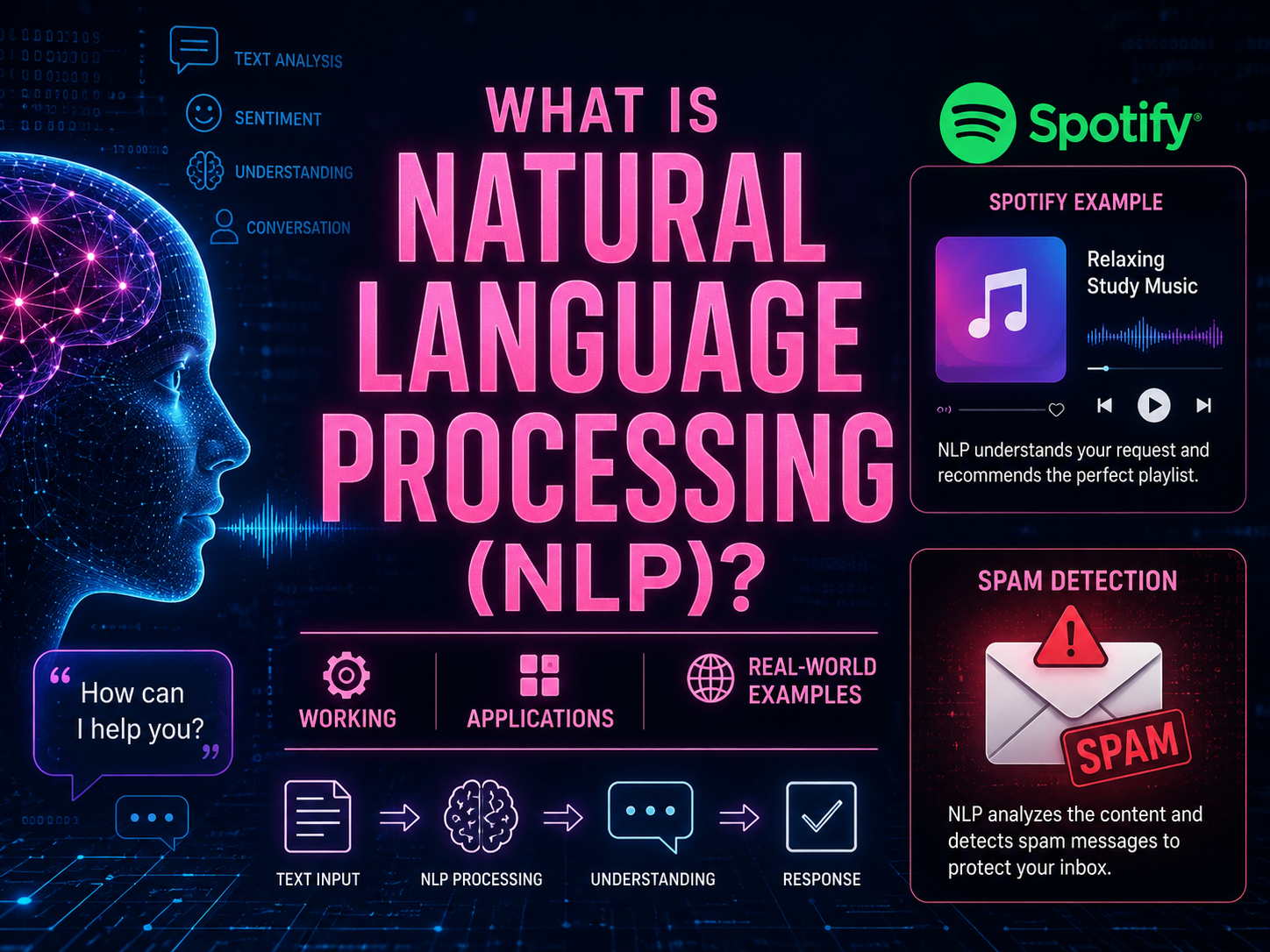
Natural Language Processing (NLP) is one of the most significant areas of artificial intelligence (AI) and is widely used by organizations to automate communication tasks, analyze massive volumes of text data and increase customer service. NLP is now more complex and popular than ever because of the emergence of AI tools like ChatGPT, Google Translate, Siri and Alexa.
This article will discuss NLP’s definition, working, real-world examples, applications, advantages and disadvantages.
What is Natural Language Processing (NLP)?
Natural Language Processing (NLP) is a branch of artificial intelligence which enables computers to understand and analyze human languages, including English, Hindi, Spanish etc. Grammar, emotions, slang, abbreviations and multiple meanings for the same words all contribute to the complexity of human language. NLP enables machines to fully understand this language and produce insightful answers.
NLP’s primary objective is to close the gap between machine knowledge and human communication. It makes possible for computers to figure out speech, read text, respond to enquiries and even create the content.
How Natural Language Processing (NLP) Works?
Deep learning methods, computational linguistics and machine learning algorithms are all combined in natural language processing. Typically, the workflow includes a number of phases that help in language understanding for computers.
- Speech or Text Input
When the computer receives input from language in the form of text or voice, the process begins. For example, a user might speak a command or type a message.
- Use of Tokens (Tokenization)
The text is broken up into smaller units known as tokens. These tokens could be sentences, phrases or words. Tokenization improves the computer’s ability to analyze language.
- Removing Stop Words
Since they don’t add much to the sentence, common words like “is”, “the” and “and” are frequently eliminated.
- Understanding Importance
To determine the text’s meaning, the NLP system examines grammar, sentence structure and context. Massive datasets are used to train machine learning algorithms to identify word correlations and patterns.
- Delivering Results
The system produces a response or carries out a task, such as interpreting text, responding to enquiries or summarizing data, after understanding the input by the user.
Neural networks and deep learning models are also used by modern NLP systems to enhance the accuracy and provide responses that are more human-like.
Real-World Examples of NLP
Example 1: Voice Assistant
Let’s imagine a user approaches a virtual assistant with:
“Play party songs on Spotify.”
Here’s how NLP functions in this scenario step-by-step:
- Recognition of Speech
The spoken voice is first translated into text by the system.
Voice Input:
“Play party songs on Spotify.”
Text Conversion:
“Play party songs on Spotify.”
- Use of Tokens (Tokenization)
The statement is broken up into tokens, which are smaller words:
- Play
- Party
- Songs
- On
- Spotify
- Understanding Intent
The user’s desire to play music is recognized by the NLP system.
Additionally, it identifies crucial keywords:
“Spotify” → music platform
“party” → music genre/mood
- Handling the Request
The AI connects to Spotify and looks for playlists or party music.
- Producing the Result
Lastly, the assistant replies something along these lines:
“Playing party songs on Spotify.”
After that, the music begins to play on its own.
This example demonstrates how NLP enables computers to fully understand human language, evaluate meaning and instantly deliver helpful answers.
Example 2: Identifying Spam Emails
Let’s say you get the following email:
“Congratulations! You have won a free iPhone. Click here now!”
This is how NLP detects spam:
- Analysis of Texts
The message’s content is scanned by the email system.
- Identification of Keywords
Suspicious words and phrases are identified by the NLP model, including:
- Congratulations
- Free
- Won
- Click here
- Identification of Patterns
The email is compared by the algorithm to millions of spam email patterns that were discovered during training.
- Classification
Judging to the underlying AI, the email is probably spam.
- Last Action
The email is instantly transferred from the inbox to the spam folder.
This example demonstrates how NLP helps email systems effectively filter risky or undesired messages.
Applications of NLP
- Virtual Assistants and Chatbots
NLP is used by AI chatbots and virtual assistants such as Siri, Alexa and Google Assistant, to understand the user enquiries and deliver accurate answers.
- Machine Translation
NLP is used by translation programs like Google Translate to swiftly and precisely translate text between languages.
- Summarizing the Texts
Long articles, reports or documents can be automatically simplified into shorter forms using natural language processing.
- Analysis of Sentiment
In order to figure out the thoughts and feelings of their customers, businesses utilize natural language processing (NLP) to examine reviews, comments and social media posts.
- Spam Identification
Email providers use natural language processing (NLP) to analyze writing patterns and keywords in order to detect spam or undesired emails.
Advantages of NLP
- Better Communication
NLP makes it possible for users to communicate with computers more organically through speech and text.
- Improved Customer Experience
Chatbots driven by AI offer prompt answers to user enquiries while improving the customer experience.
- Quicker Analysis of Data
Large volumes of text data can be swiftly and effectively analyzed by organizations.
- Support for Multiple Languages
NLP makes it possible for speakers of multiple languages to communicate and translate.
Disadvantages of NLP
- Recognizing Context
Depending on the situation, words can signify multiple things. It is challenging for machines to understand the exact meaning of a sentence.
- Several Languages
Large datasets and complex designs are needed to train NLP systems for many languages.
- Data Privacy Issues
Sensitive data is frequently processed by NLP systems, which raises security and privacy issues.
- AI Model Bias
NLP models may yield unfair or inaccurate findings if training data contains bias.
Conclusion
NLP is very crucial to modern technology as it enables applications like chatbots, translation tools, speech recognition systems and virtual assistants possible. With the development of deep learning and machine learning technology, it keeps expanding quickly. NLP will become much more precise, smart and practical in our day-to-day lives as AI technology develops. NLP is revolutionizing human-computer interaction and increases the speed, intelligence and efficiency of communication on both personal and professional devices.
FAQs
- What is natural language processing (NLP) in artificial intelligence?
Natural Language Processing (NLP) is an area of artificial intelligence that helps computers to understand and process human language.
- What are NLP’s main uses?
Chatbots, translation software, voice assistants, spam filters and search engines all use natural language processing (NLP).
- Is ChatGPT an NLP example?
Indeed, ChatGPT employs machine learning and natural language processing to understand and produce text responses that resemble those of a human.
- What distinguishes machine learning from natural language processing?
While NLP focuses mainly on understanding human language, machine learning enables computers to learn from data.
- Which businesses use NLP?
NLP technologies are used by businesses such as Google, Amazon, Microsoft, Netflix and OpenAI.
Read More:
- Introduction to Machine Learning
- What is Artificial Intelligence (AI)? History, Types, Applications, Benefits & Drawbacks
- What is ChatGPT and How Does it Works?
- What is Generative AI? Working, Applications, Benefits and Drawbacks
- Top 7 AI Tools for Students