Have you ever wondered how people access their business network from anywhere in the world or safely use public Wi-Fi?. The answer is VPNs. Virtual Private Networks (VPNs) are becoming more and more popular among internet users as worries about online privacy continue to grow. However, what really is a VPN and how does it secure your information? Let’s examine VPNs functions, numerous types, advantages and typical applications.
What is a VPN?
A technology called a Virtual Private Network (VPN) establishes a safe, encrypted connection between your device and the internet. A VPN sends your internet traffic through a distant VPN server rather than transmitting it straight to a website or online service.
It shields your online activities from hackers, internet service providers (ISPs) and other third parties. Basically, this encrypted connection hides your actual IP address ensuring that websites display the IP address of the VPN server rather than your real location.
VPNs are frequently used by organizations to give employees safe remote access to company resources and by customers to improve internet privacy.
How does VPN Work?
Your device and a VPN server establish an encrypted tunnel in order for a VPN to function. Before it reaches its destination, every bit of data you send or receive passes through this safe tunnel.
This is how the procedure operates:
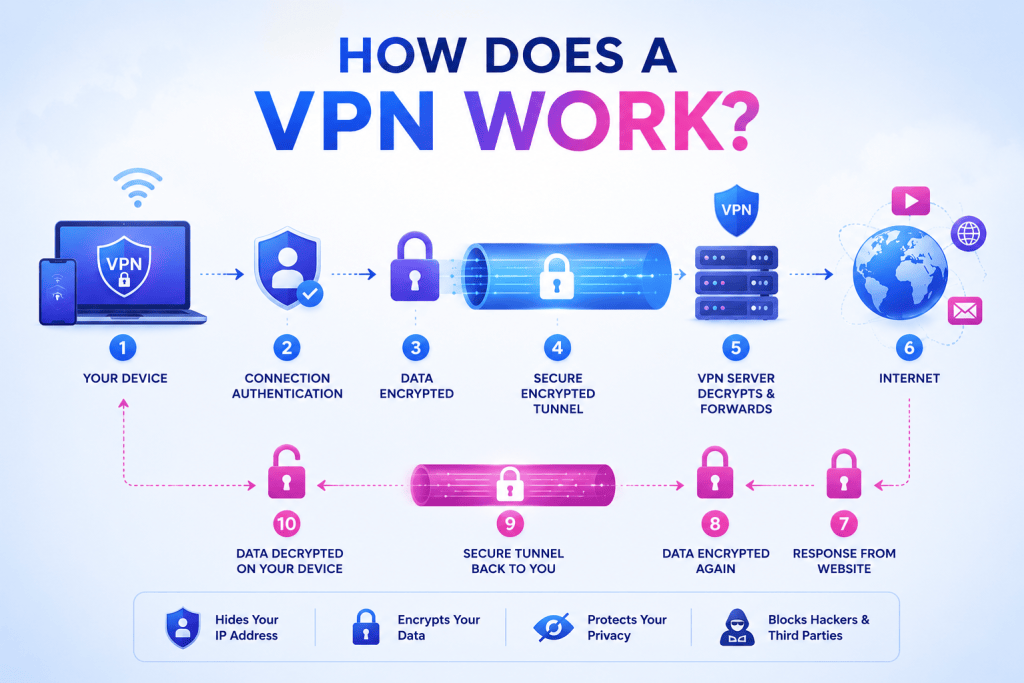
- Using a VPN app on your device, you establish a connection to a VPN.
- Your connection to the VPN server is verified by the VPN program.
- Before it leaves your device, your internet traffic is encrypted.
- The encrypted data is sent to the VPN server over a secure tunnel.
- After decrypting the data, the VPN server sends it to the intended website or online service.
- The VPN server receives a response from the website and encrypts the data once again before returning it to your device.
Types of VPN
- Remote Access VPN
Individual users can safely connect to a private network through the internet from any location using a Remote Access VPN. Employees who work remotely frequently use it to access internal systems, company files and apps.
- Site to Site VPN
A Site-to-Site VPN uses the internet to safely link two or more business networks. This kind of VPN is used by companies with several branches so that workers at various places can share resources and interact as if they were on the same local network.
- SSL VPN
Secure remote access through a web browser or a lightweight client is made possible by an SSL (Secure Sockets Layer) VPN. Employers frequently use it to let staff members access internal apps without requiring a complete VPN installation.
- Mobile VPN
Mobile VPNs are made for mobile devices such as tablets and smartphones. It is an excellent option for people who usually travels alot as it keeps a steady and secure connection even when users switch between mobile data and Wi-Fi networks.
Uses of a VPN
- Protecting public Wi-Fi networks while using the internet.
- Working remotely while safely accessing corporate systems.
- Protecting private data when purchasing and banking online.
- Obtaining corporate resources from many areas.
- Minimizing online tracking by websites and advertising.
- Safely connecting when on the road.
- Preserving more privacy when using the internet on a daily basis.
Advantages of VPN
- It hides your IP address from websites and other parties, protecting your privacy.
- It makes it more difficult for hackers to steal private information by encrypting internet transmission.
- It improves the security of public Wi-Fi networks found in hotels, cafes, airports and other public areas.
- It allows employees to safely access company resources, enabling secure remote work.
- It minimizes tracking by restricting the ways in which websites and advertising may identify your online behavior.
- It connects through servers located in many nations to provide access to geo-restricted material.
- Protects your internet connection to enable safer online banking and shopping.
Disadvantages of VPN
- Internet speed may be slightly slowed by encryption.
- Free VPN services may have data limitations, slow performance or few features.
- Malware, phishing scams and dangerous websites cannot be totally prevented with a VPN.
- Known VPN servers may be blocked by some websites and streaming services.
- To guarantee that their data is treated appropriately, users must still select a reliable VPN provider.
Conclusion
A VPN is an excellent tool to protect internet connections and improve online privacy. It helps in protecting the important information when surfing, working remotely or using public Wi-Fi by encrypting your data and hiding your IP address. A dependable VPN, though not a complete cyber security solution but is essential to preserving a more secure and private online experience.
FAQs
- What are the main goals of a VPN?
Encrypting your internet connection, protecting your online privacy and hiding your IP address are the main goals of a VPN.
- Does VPN make internet completely private?
No. By encrypting your communication and hiding your IP address, a VPN improves privacy but it does not grant you total privacy online.
- Can VPN improve internet speed?
As your data is encrypted and sent through a VPN server, a VPN marginally slows down your internet. In other circumstances, though, if an ISP restricts connection speeds, it could improve performance.
- Is VPN legal?
Indeed, VPNs are permitted in several nations. Users should verify local laws before using one, though, as several countries limit or control their use.
- Should I use VPN all the time?
A VPN can give an extra degree of security if you work remotely, use public Wi-Fi frequently or want more privacy when using the internet.
Read More:
- What Is Cyber Security? Types, Threats and Best Practices
- What Is Cloud Computing? How It Works, Types, Benefits & Examples
- What is Authentication? Types, Techniques and Applications
- What is Socket in Computer Networks? Working, Types and Applications
- What Is a Vector Database? How AI Stores and Retrieves Information