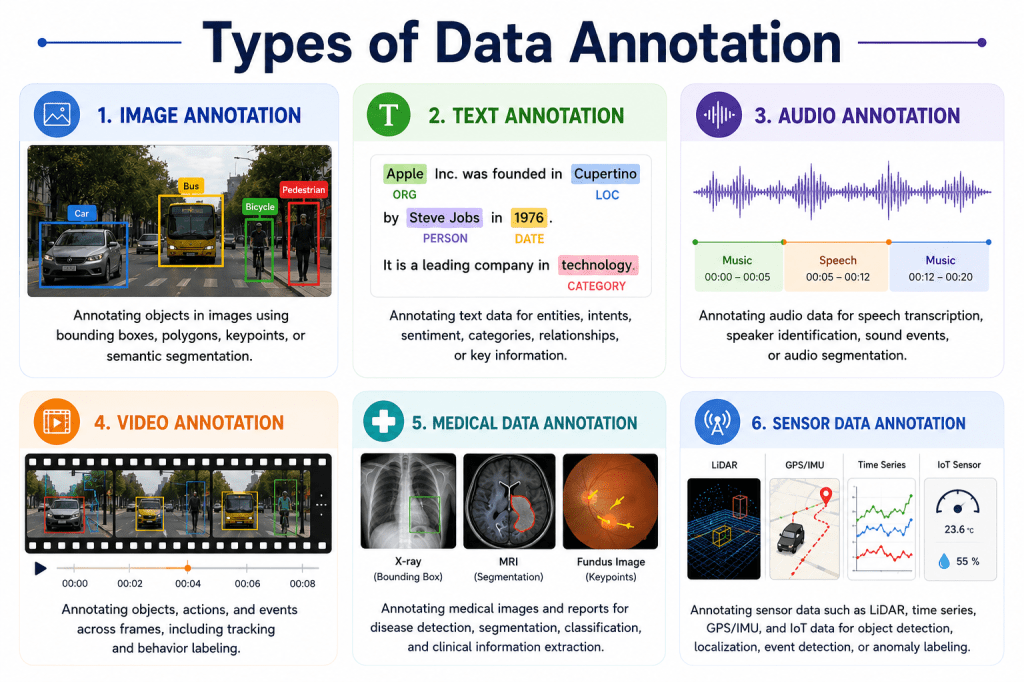
Data Annotation is the process of annotating raw data with relevant details or metadata to make it understandable and useful for machine learning algorithms. This metadata can contain a wide range of information like categories, tags, annotations and other descriptors. This provides context or meaning to the data. Data points can be given context, structure or significance by annotating or labelling them. Data Annotations work as the foundation for training machine learning algorithms to identify patterns, generate predictions and extract insights.
Types of Data Annotations
An essential step in training machine learning (ML) and artificial intelligence (AI) models, data annotation is the process of labelling or tagging data so that machines and AI systems is capable of understanding from it. Depending on the format of the data, such as text, images, audio, or video, different annotation techniques are needed. It is a crucial stage in the training of models for artificial intelligence (AI) and machine learning (ML). Depending on the format of the data—text, photos, audio, or video, for example- different annotation techniques are needed.
- Text Annotation
The practice of labelling textual material so that machines can comprehend words, sentences, emotions, and meanings is known as text annotation. It is mostly utilized in Natural Language Processing (NLP), which teaches AI computers how people speak. Machines can recognize intentions, entities, sentiments, syntax, and crucial information from written content with the aid of this kind of annotation. Chatbots, search engines, email filtering, suggestions and virtual assistants all make a great deal of text annotation.
Example:
While gathering feedback from the customer, a business may classify comments as neutral, negative or positive. For example, “The product quality is excellent” can be classified as positive, whereas “The delivery was very slow” can be classified as negative. This helps AI systems in automatically analyzing consumer feedback and boosting customer support tactics.
- Image Annotation
In order for computer vision algorithms to identify and understand visual objects, image annotation involves labelling images. Bounding boxes, polygons, landmarks, or segmentation techniques are used in this process to mark objects within photographs. It aids machines in identifying a variety of items, including people, cars, buildings, highways, and animals. Facial recognition, driverless cars, medical imaging, agriculture, and security systems all frequently use image annotation. AI systems can make precise visual decisions with the help of high-quality image annotation.
Example:
Drawing boxes around vehicles, pedestrians, traffic signals and road signs are used to annotate thousands of traffic photos in a self-driving automobile system. While driving, the AI model gains the ability to identify these objects. This enables the car to recognize barriers, obey traffic laws and avoid clear of mishaps.
3. Audio Annotation
The technique of labelling sound recordings so that machines can comprehend speech, noises, and voice patterns is known as audio annotation. It involves text-to-speech conversion, speaker identification, emotion detection, and background sound recognition. Voice assistants, automated call centers, speech recognition software, and transcription software all depend on audio annotation. AI systems are better able to understand human interactions and provide appropriate responses when they use annotated audio data.
Example:
Annotated audio recordings that translate spoken commands into text are used to educate voice assistants like Siri and Alexa. For instance, the AI learns the voice command “Play music” because it is appropriately labelled. The algorithm eventually has the ability to identify various dialects, speech patterns, and tones.
4. Video Annotation
The technique of labelling objects, actions, or events in video files frame by frame is known as video annotation. Annotation assists AI systems in tracking objects and understanding activities over time because films feature continuous motion. Applications for activity recognition, autonomous driving, sports analysis, and surveillance systems all use this kind of annotation. Motion analysis and image recognition are combined in video annotation to improve knowledge of dynamic surroundings.
Example:
Video annotation is used in sports analytics to monitor player’s movements throughout a football game. AI system recognize the passes, goals, player placements and running patterns. This data is used by analysts and coaches to evaluate team performance while improving tactics.
5. Sensor Data Annotation
The process of labelling data gathered from sensors, including GPS trackers, temperature sensors, motion detectors, and wearable technology, is known as sensor data annotation. It aids in the interpretation of machine activity, bodily movements, and environmental factors by AI systems. IoT devices, industrial automation, smart homes, fitness tracking systems, and healthcare monitoring all make significant use of sensor annotation.
Example:
Sensor data on running, walking, heart rate, and sleep patterns is gathered by a fitness smartwatch. To accurately determine various activities, the gathered data is annotated. This enables the gadget to track health problems, compute calories burnt, and offer customers fitness advice.
6. Medical Data Annotation
Labelling healthcare-related data, including X-rays, MRIs, CT scans, medical reports and pathology images is known as medical data annotation. It assists AI systems in diagnosing illnesses, spotting issues and supporting medical professionals. As medical information must be extremely correct, this kind of annotation calls for specialist understanding. Medical research, disease prediction and healthcare automation are using medical annotation more and more.
Example:
Tumour zones in MRI or CT scan pictures are annotated by radiologists in cancer detection systems. To understand how dangerous tissues look, the AI model examines these indicated areas. Subsequently, the technology can help physicians by rapidly detecting potential tumours and increasing the accuracy of diagnoses.
Importance of Different Types of Annotation
- Enhances AI Model Accuracy: AI systems can learn from accurately labelled data due to data annotation, which increases prediction accuracy. Machine learning models also produce more accurate and dependable conclusions when they have access to well-annotated data.
- Assists in Data Understanding for Machines: Annotation transforms raw data into information that AI systems understand. It makes it possible for machines to more successfully identify text, pictures, sounds, videos and patterns.
- Reduces Errors and Bias: Annotated data minimizes errors and enhances AI system’s fairness. Accurate and balanced data are used to train models due to high-quality labelling.
- Crucial to the Development of AI and Machine Learning: AI and machine learning systems cannot learn efficiently without labelled data. The basis for creating clever and effective AI applications is data annotation.
- Promotes Better Decision-Making: Accurate annotation helps situation analysis and intelligent decision-making by AI systems. It is very good applications like financial systems, driverless cars and healthcare.
- Encourages Automation: AI models are trained using annotated data to carry out tasks autonomously without continuous human intervention. This increases productivity in sectors including manufacturing, security and customer service.
Conclusion
Data annotation transforms raw data into meaningful information that machines can understand. From chatbots and recommendation systems to self-driving cars and healthcare solutions, data annotation is used. Understanding these data annotation types helps businesses, developers and AI professionals choose the best approach to create accurate and efficient AI models.
FAQs
Which organizations use data annotation the most?
Data annotation is used in organizations like healthcare, automobile, retail, security, finance and technology the most. It is crucial to the creation of automation systems and AI-powered apps.
What difficulties arise with data annotation?
Time consumption, high expenses, accuracy maintenance, managing big datasets, and minimizing bias in labelled data are typical obstacles. Another crucial issue with annotating efforts is quality control.
Which tools are frequently used for data annotation?
Labelbox, CVAT, V7, SuperAnnotate, and Prodigy are well-known tools for data annotation. These technologies assist effective annotation of text, pictures, videos and audio.
Which organizations use data annotation the most?
Data annotation is widely used in industries like healthcare, automobile, retail, security, finance and technology. It is very important to create automation systems and AI-powered applications.
What is 3D point cloud annotation?
Three-dimensional spatial data obtained from LiDAR or depth sensors is labelled using 3D point cloud annotation. It is mostly utilized in augmented reality systems, robots and driverless cars.
 The Prism Nova
Leave a comment