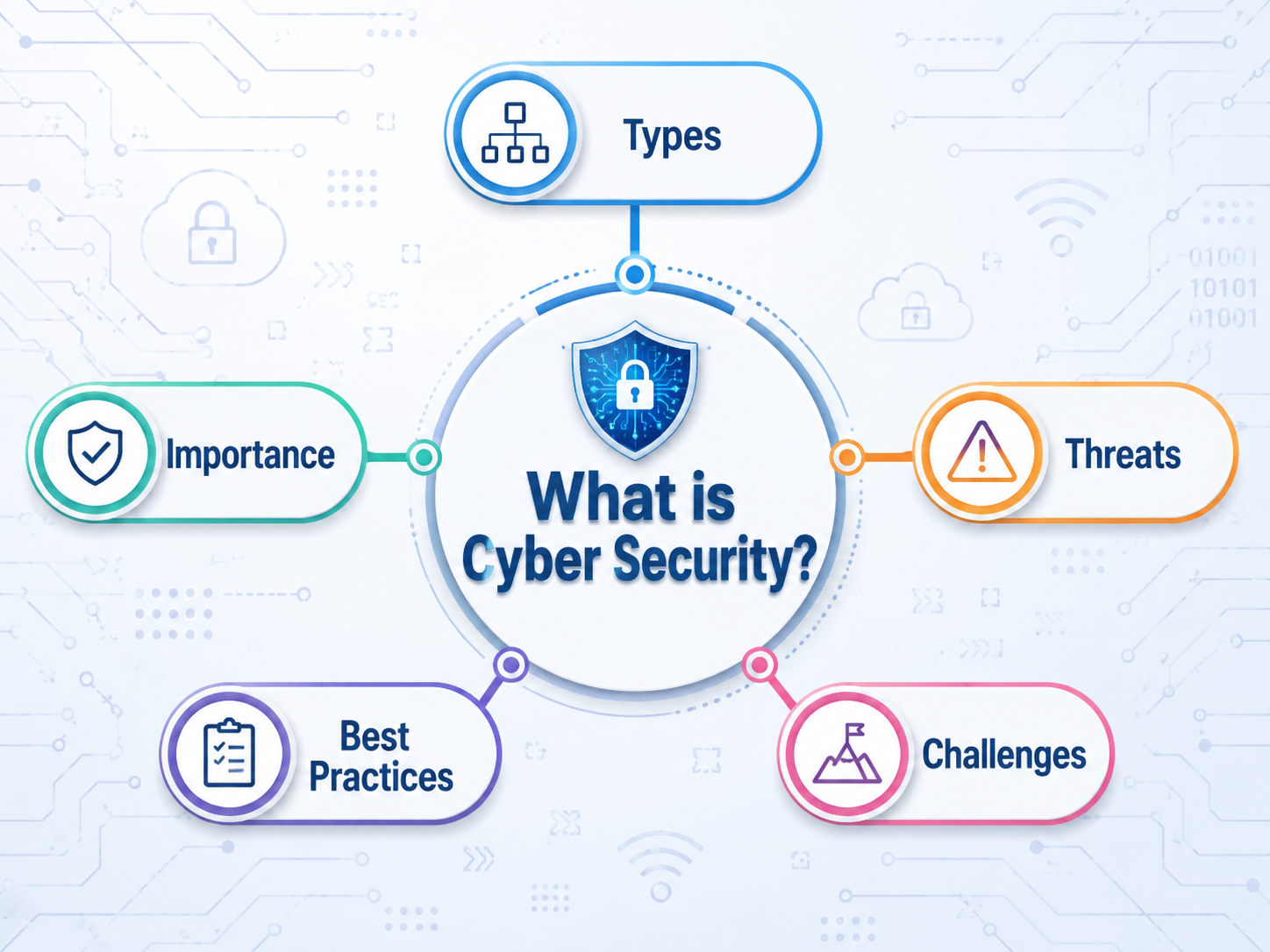
In the modern digital age, we use the internet for work, banking, shopping, communication and education. Although technology has made life easier, it has also made it easier for hackers to take advantage of security flaws, disrupt systems and steal data. Cybersecurity is becoming more crucial than ever because of this.
Table of Contents
What is Cyber Security?
The technique of preventing cyberattacks, illegal access, theft and damage to computers, networks, devices, apps and data is known as cyber security. It involves protecting sensitive data and digital systems from cybercriminals by using security policies, procedures and technology.
Ensuring the confidentiality, integrity and availability (CIA) of data while reducing the risks associated with cyber threats is the main goal of cyber security.
How Does Cyber Security Work?
In order to protect systems from cyber threats, cyber security combines several layers of defense. Organizations use a variety of technologies, policies and best practices to mitigate vulnerabilities and prevent threats rather than depending solely on one security strategy.
For example, encryption protects private information, firewalls keep an eye on all incoming and outgoing network traffic, antivirus software finds and eliminates harmful software and multi-factor authentication (MFA) confirms user identities before allowing access. Organizations also use security updates to fix newly found vulnerabilities, keep an eye on their systems and spot suspicious activity.
When combined, these security measures help in attack prevention, early threat detection and damage minimization in the case of an occurrence.
Types of Cyber Security
- Network Security
Computer networks are shielded from malware, cyberattacks and unwanted access by network security. To secure network traffic, it makes use of mechanisms like firewalls, virtual private networks (VPNs), intrusion detection systems (IDS) and intrusion prevention systems (IPS).
- Application Security
Protecting software and web applications from vulnerabilities during development and deployment is the main goal of application security. It consists of vulnerability assessments, software updates, frequent security testing and secure coding techniques.
- Information Security
Sensitive data is protected from unwanted access, alteration, disclosure or destruction by information security (InfoSec). It uses data backup techniques, access controls and encryption to guarantee the availability, confidentiality and integrity of information.
- Cloud Security
Cloud-based services, apps and stored data are all protected by cloud security. To lower security threats in cloud systems, it involves identity management, encryption, safe setups, ongoing monitoring and accordance to industry standards.
- Endpoint Security
Devices connected to a network, including laptops, desktop computers, cellphones, tablets and servers are protected by endpoint security. To stop cyberattacks, it uses device encryption, endpoint detection and response (EDR), antivirus software and frequent upgrades.
- Internet of Things (IoT) Security
IoT security uses secure firmware, authentication, encryption and frequent software upgrades to shield linked devices from cyber threats, including wearable technology, medical equipment, industrial sensors and smart home appliances.
Importance of Cyber Security
- It prevents unwanted access to private and sensitive company information.
- It stops financial losses brought on by internet fraud and cybercrime.
- It preserves client confidence by guaranteeing data confidentiality and privacy.
- It helps businesses in meeting legal and regulatory obligations.
- It protects vital infrastructure, including banking, healthcare, transportation and energy systems.
- It minimizes the downtime that cyber attacks generate for businesses.
- It protects private company data and intellectual property.
- It promotes digital transformation and safe cloud computing.
- It permits secure digital conversations and online transactions.
- It improves the company’s capacity to identify and address online threats.
Common Cyber Security Threats
- Malware
Malware is malicious software that is intended to harm, interfere with or obtain unauthorized access to computer systems. Viruses, worms, Trojan horses, spyware, ransomware and adware are all the examples of malware.
- Phishing
Phishing attacks use fake emails, websites, texts or social media posts to deceive people into revealing private information, including passwords, credit card numbers or personal information.
- Ransomware
Malware that encrypts files or locks computer systems and requests a ransom to unlock it is known as ransomware. Both major financial losses and operational interruptions may result from it.
- Distributed Denial-of-Service (DDoS) and Denial-of-Service (DoS) Attacks
These attacks prevent genuine users from accessing websites or online services by flooding a server or network with excessive traffic.
- Attacks Using Passwords
In order to obtain unauthorized access to user accounts and systems, password attacks use methods including dictionary attacks, credential stuffing and brute-force attacks.
- Man-in-the-Middle (MitM) Attacks
In a Man-in-the-Middle attack, a cybercriminal secretly eavesdrops on conversations between two parties in order to acquire confidential data or modify transmitted data without the parties knowledge.
- Social Engineering
Manipulating people into disclosing private information or taking acts that jeopardize security is known as social engineering. These attacks leverage human behavior and trust rather than technological flaws.
Best Practices for Cyber Security
- Make sure each account has a strong, one-of-a-kind password.
- Whenever possible, turn on multi-factor authentication (MFA).
- Update your devices, apps and operating system.
- Avoid from opening unexpected attachments or clicking suspicious links.
- Install reliable anti-malware and antivirus programs.
- Make regular backups of crucial files.
- When accessing sensitive data on public networks, use a VPN and encrypted Wi-Fi networks.
- To stop unwanted access, encrypt sensitive data.
- Keep an eye out for strange activity on accounts and systems.
- Inform users about internet fraud and phishing attacks.
Real-World Applications of Cyber Security
- Banking and Finance: Prevents fraud and cyberattacks on internet banking, payment systems, ATMs and financial transactions.
- Healthcare: Prevents unwanted access to patient data, medical devices and electronic health records (EHRs).
- Government: Protects public services, private documents and national infrastructure against cyberattacks.
- Education: Safeguards university networks, online learning environments and student records.
- Cloud computing: Protects remote data storage, virtual servers and cloud apps.
- Manufacturing: Prevents cyber threats to supply chain activities, linked machinery and industrial control systems.
Challenges of Cyber Security
- Rapidly changing attack methods and cyberthreats.
- IoT systems and connected devices are growing in number.
- Lack of qualified experts in cyber security.
- Lack of security awareness and human error.
- Managing security in hybrid and cloud settings.
- Identifying complex attacks before they have a chance to do harm.
- Striking a balance between user comfort and solid security.
Conclusion
Cybersecurity is become a need rather than an option as our dependence on digital technology increases. People and organizations may lower risks, stop cyberattacks and preserve confidence in the digital world by safeguarding data, networks and apps.
The first steps to remaining secure online are to understand the many forms of cyber security, identify common dangers and stick to fundamental security best practices. Maintaining strong security measures and remaining updated are crucial for long-term digital safety since cyber threats are always changing.
Read More
- What Is Cloud Computing? How It Works, Types, Benefits & Examples
- What is Authentication? Types, Techniques and Applications
- What is Socket in Computer Networks? Working, Types and Applications
- Types of Sockets in Computer Networks
- What is OCR? How Optical Character Recognition Works & Its Applications