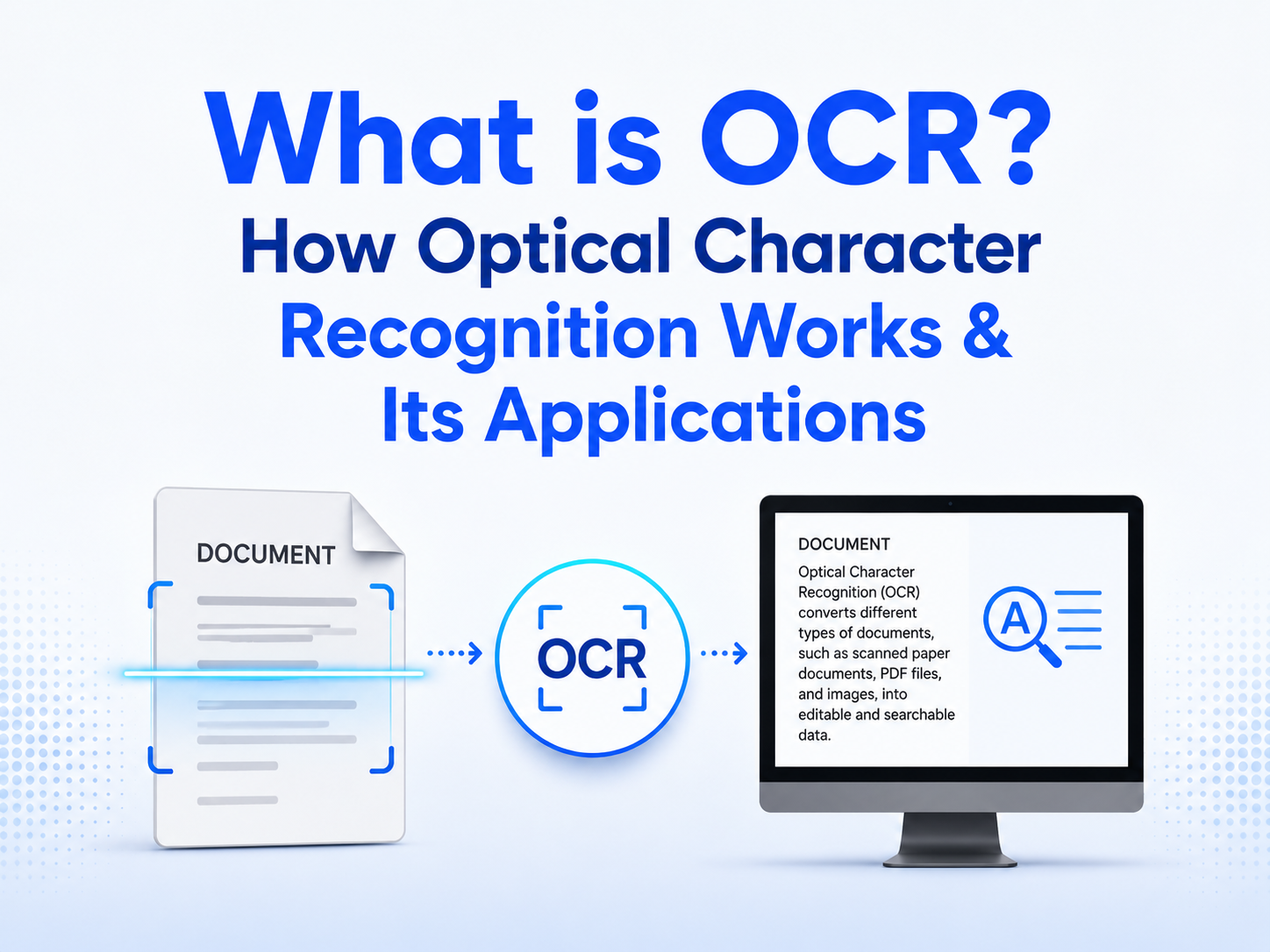
Large amounts of printed documents, forms, invoices and records that must be digitally processed or saved are handled by people and organizations on a daily basis. It takes a lot of time and is likely to make mistakes to manually insert data from these papers. Transforming text from scanned documents and pictures into editable, searchable and machine-readable digital text, Optical Character Recognition (OCR) speeds up and improves document processing.
What is OCR?
OCR stands for Optical Character Recognition which transforms the handwritten or printed text from scanned documents, images or photographs containing text into digital text that can be read by computers. It allows text that would otherwise just exist as an image to be recognized, extracted and processed by computers. Many software programs can be used to edit, search, copy, store or analyze the extracted text. OCR is frequently used to increase the accessibility of digital information, decrease manual data entry and automate document processing.
Applications of OCR
- Banking and Financial Services
OCR enables quicker transactions and digital KYC verification by processing checks, invoices, receipts and identity papers.
- Healthcare
To provide faster access and effective record management, hospitals use OCR to electronically store patient data, medications and medical reports.
- Business Document Automation
To reduce human data entry and increase workflow efficiency, businesses use optical character recognition (OCR) to extract data from contracts, purchase orders, invoices and forms.
- Transportation and Logistics
In order to help with traffic control and speed logistical operations, OCR recognizes car license plates, shipment labels and delivery paperwork.
- Education and Digital Archives
To make books, research papers and historical records searchable and easier to preserve, libraries, educational institutions and government agencies use optical character recognition (OCR).
History of OCR
OCR was first proposed in the early 1900s. In 1910s and 1920s, devices for recognizing printed characters were created. OCR became much more useful in 1974 when Ray Kurzweil developed one of the first omni-font OCR systems that could identify text printed in different fonts. Since then, machine learning, deep learning, and artificial intelligence have greatly increased OCR, resulting in significantly higher accuracy across a variety of languages and document types.
Working of OCR
- Image Acquisition
Using a scanner, smartphone camera or digital image, the document is first captured.
- Image Preprocessing
By eliminating noise, adjusting brightness and contrast, straightening tilted pages (deskewing) and boosting text clarity for improved recognition, the OCR system improves the image.
- Text Detection
The program recognizes text-containing areas of the image while excluding non-text components like backdrops or graphics.
4. Character Recognition
After analyzing the identified text, AI-powered OCR models identify individual words, phrases and characters. Instead of depending solely on conventional pattern matching, modern systems use deep learning techniques.
- Post-processing
To fix spelling errors and increase overall accuracy, the identified text is examined using dictionaries, language models and context analysis.
- Output Generation
In order to save, search, edit and integrate the extracted text with other business applications, it is finally transformed into editable and searchable forms as TXT, DOCX, PDF or spreadsheet files.
Advantages of OCR
- Digitalization of Text
OCR makes it simpler to store, modify, copy and distribute the documents electronically by converting handwritten or printed text into a machine-readable digital format.
- Searchability
It enables users to swiftly find particular words, phrases or information inside vast document collections by making scanned documents and images searchable.
- Time and Money Savings
OCR dramatically lowers manual data entry, minimizes human error and saves time and operating expenses by automating data extraction from documents.
- Document Management and Archiving
OCR streamlines the digitization of paper documents and archives, lowering the need for physical storage while improving document retrieval and organization.
- Support for Multiple Languages
Many languages and scripts are supported by contemporary OCR systems, which makes them helpful for companies and organizations that operate in many geographical areas.
- Workflow Automation Driven by AI
By automatically extracting data from invoices, receipts, forms, identity documents and contracts, modern OCR connects with AI-powered document processing systems to improve productivity and streamline business processes.
Disadvantages of OCR
- Proofreading might still be necessary.
Even though AI-powered OCR is very precise, errors might still happen because of damaged documents, odd fonts or low image quality. Human verification may still be necessary for important documents.
- Handwriting Difficulties
Although many varieties of handwritten text may be recognized by modern OCR, recognition accuracy can still be lowered by poor handwriting, cursive writing or poor quality photos.
- Privacy and Security Issues
Sensitive data, including bank records, medical records and personal identification is frequently processed using OCR systems. This data could be subject to misuse or illegal access if appropriate security measures aren’t in place.
- Cost
Some businesses may find it costly to pay subscription or licensing fees for advanced OCR solutions with AI capabilities, cloud services and enterprise features.
- Limited Knowledge of Context
When context is unclear, OCR may still mistake words or sentences because its primary concentration is text recognition. Even though AI has improved contextual knowledge, complicated papers could still require human evaluation.
Conclusion
OCR has emerged as a crucial tool for minimizing manual labor and simplifying the access, organization and analysis of information. It plays a huge role in variety of sectors, including banking, healthcare, education and logistics due to its capacity to speed up document processing. It will become more crucial in boosting productivity, facilitating automation and enabling more intelligent data-driven workflows as companies continue to embrace digital transformation.
Read More:
- What is Artificial Intelligence (AI)? History, Types, Applications, Benefits & Drawbacks
- Introduction to Machine Learning
- What is Deep Learning? How it Works, Key Components, Types and Applications
- Neural Networks Explained: How They Work, Types & Applications
- What Is Multimodal AI? How AI Understands Text, Images, and Audio
Leave a Reply