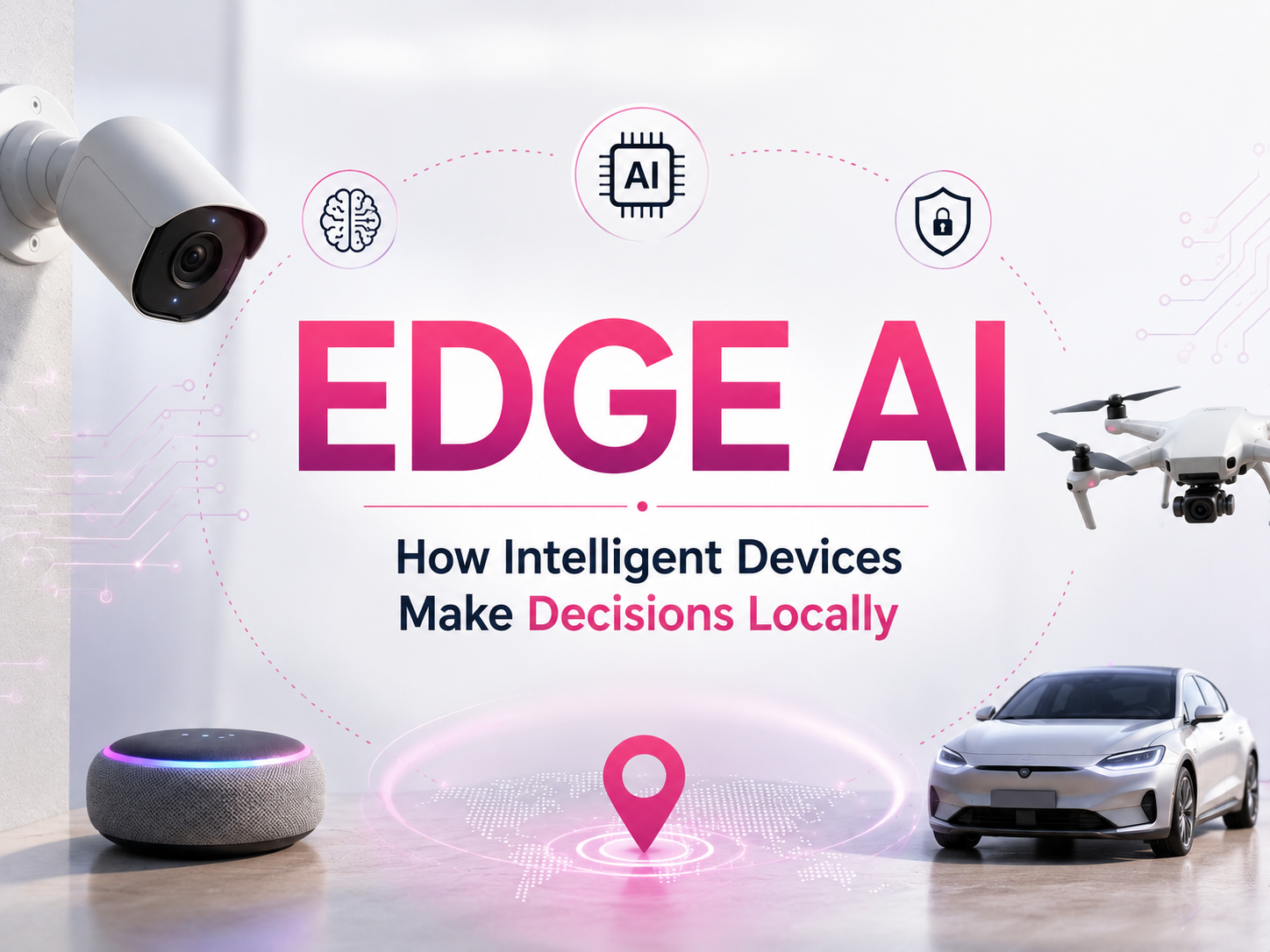
Strong cloud servers are no longer the only source of artificial intelligence. These days, a lot of smart devices don’t always need an internet connection to decode data and make wise judgements. Here, Edge AI comes into play. It is a crucial component of modern applications because it brings AI closer to the point of data generation, enabling quicker answers, improved privacy and more effective performance.
Table of Contents
What is an Edge AI
Instead of transferring data to distant cloud servers for processing, edge AI involves deploying and running artificial intelligence (AI) models directly on edge devices.
Any device that is situated near the location of data generation is considered an edge device. Smartphones, smart cameras, wearable technology, drones, industrial robots, driverless cars and Internet of Things (IoT) devices are some examples of these gadgets.
In standard cloud-based AI, a device gathers data and transmits it to a cloud server, where an AI model analyses it and provides the outcome. Although this method is effective for many applications, it may cause delays and necessitates a reliable internet connection.
By analyzing data locally on the device, Edge AI resolves this issue. As a result, devices become less dependent on cloud infrastructure and are able to make intelligent judgements virtually quickly.
How does Edge AI Work?
Edge AI examines data near its source by combining edge computing with deep learning or machine learning algorithms.
These steps are often involved in the process:
- Data Collection: Using cameras, microphones, sensors, GPS and other input sources, the edge device gathers data.
- Local Processing: The device’s pre-trained AI model examines the incoming data.
- Making Decisions: Using the processed data, the AI model recognizes objects, finds patterns or makes predictions.
- Action: If more analysis or storage is required, the device sends only the relevant information to the cloud or completes the necessary action right away.
For Example,
Think about a smart security camera that is placed outside a home. The camera use an AI algorithm to identify people, cars or strange activity rather than continuously transmitting video material to the cloud. It immediately alerts the homeowner if it detects a possible threat. This offers quicker replies while using less bandwidth.

Applications of Edge AI
- Smart Monitoring
Without constantly transmitting footage to the cloud, modern security cameras employ Edge AI to recognize faces, identify suspicious activity, detect unauthorized access and provide real-time alerts.
- Healthcare
Edge AI is used by wearable technology, including fitness trackers and smartwatches, to track physical activity, blood oxygen levels, heart rate and sleep patterns. Certain medical devices have the ability to identify unusual health situations and promptly alert users.
- Self-Driving Cars
Huge data from cameras, radar, LiDAR and sensors are processed by self-driving vehicles. The car can detect pedestrians, avoid obstructions, identify traffic signs and make driving judgements in milliseconds due to Edge AI.
- Smart Homes
Edge AI is used by voice assistants, smart doorbells, home security systems and smart thermostats to automate everyday tasks and react fast to user requests without relying solely on cloud services.
- Manufacturing
Edge AI is used in factories for equipment monitoring, quality inspection, predictive maintenance and fault detection on line of production. This lowers interruption and increases production.
Benefits and Challenges of Edge AI
Benefits
- Faster Response Time: Local data processing allows for minimal delay in real-time decision-making.
- Increased Privacy: Prevents the need to send sensitive data over the internet by storing it on the device.
- Decreased Bandwidth Usage: Reduces network traffic by sending only necessary data to the cloud.
- Operates Offline: Performs AI functions even when there is little to no online access.
- Lower Cloud Costs: By processing data locally, it lowers cloud storage and computation costs.
Challenges
- Limited Computing Resources: Compared to cloud servers, edge devices have lower processor, memory and storage capabilities.
- Battery Consumption: Constant AI processing can cause compact gadgets batteries to run out more quickly.
- Model Optimization: In order for AI models to function well on edge devices, they frequently need to be compressed and optimized.
- Security Risks: If edge devices are not secure enough, they could be subject to physical manipulation or cyberattacks.
- Device Management: It might be challenging to update and maintain AI models across numerous edge devices.
Edge AI vs Edge Computing
Despite their constant similarity, these terms have distinct meanings.
The more general idea of processing data close to its source rather than depending on centralized cloud servers is known as edge computing. It covers activities including networking, communication, local data processing and storage. Running AI models on edge devices to make intelligent decisions locally is the focus of edge AI, a particular application of edge computing.
In short, Edge AI adds intelligence to the infrastructure that Edge Computing delivers.
Conclusion
By pushing AI closer to the point of information generation, edge AI is revolutionizing how intelligent devices analyze and react to data. It is becoming a more important technology due to its capacity to provide real-time choices, improve privacy, reduce dependence on the internet and support a variety of applications. Edge AI will be crucial for improving the speed, intelligence and efficiency of smart devices as they continue to expand across industries.
FAQs
- What is Edge AI?
The use of artificial intelligence directly to gadgets, such as smartphones, cameras, sensors or Internet of Things devices, enables them to process data and make choices locally rather than depending on cloud servers. This is known as edge AI.
- Can Edge AI function without the cloud?
Indeed. While the cloud may still be used for model updates, analytics or data backup, many Edge AI applications may function independently without a cloud connection.
- How Cloud AI is different from edge AI?
While Cloud AI processes data on distant servers that offer more processing capacity but may cause network delays, Edge AI processes data locally on devices for quicker replies.
- Does Edge AI make use of machine learning?
Indeed, edge AI typically uses pre-trained machine learning or deep learning models for local inference on edge devices.
Read More
- Edge Computing Explained: How It Works and Why It Matters
- Neural Networks Explained: How They Work, Types & Applications
- AI in Healthcare: Applications, Benefits, Challenges & Future
- AI in Cybersecurity: Applications, Benefits and Challenges
- What is AI Inference? How AI Models Make Predictions