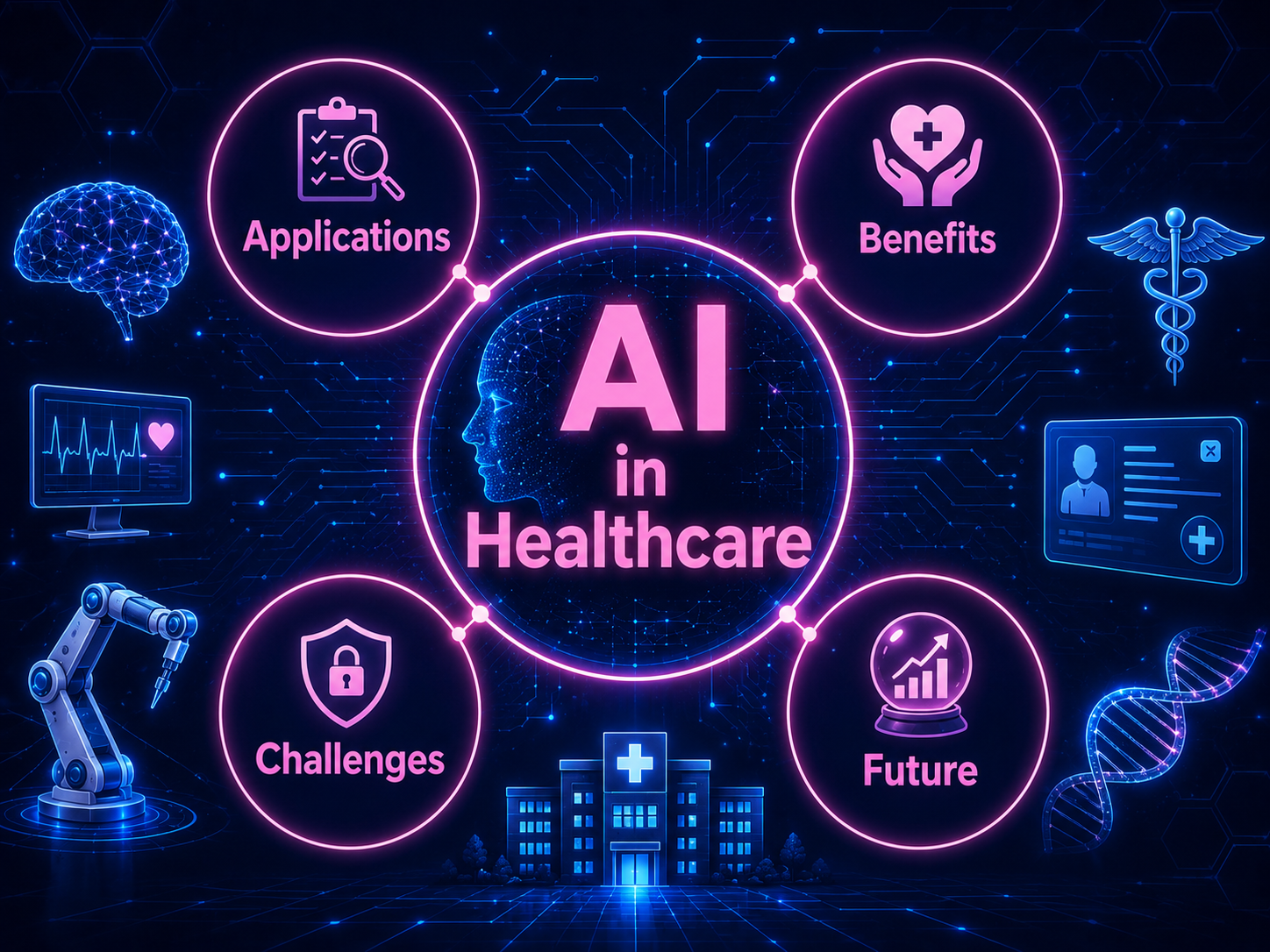
Healthcare is transforming continuously due to the expanding demands of both patients and medical experts. Artificial Intelligence (AI) has become an effective tool that is changing the administration and provision of healthcare services. AI is helping in the development of better, more effective healthcare systems as it is combining modern technology with medical knowledge.
AI in Healthcare
The use of artificial intelligence (AI) technologies to carry out tasks that usually needs human intelligence is referred to as AI in healthcare. It helps in predicting health risks, identifying the patterns in diagnostic images, evaluating the medical data and supporting treatment planning of the patient.
Healthcare data is processed by AI systems using technologies like machine learning, deep learning and natural language processing (NLP). The systems can spot patterns and produce insights that assist healthcare professionals in making better decisions by learning from huge datasets. AI serves as a powerful helper that improves medical practice and healthcare delivery rather than taking the place of human expertise.
Importance of AI in Healthcare
AI is becoming more crucial in the healthcare sector due to a number of issues. One important issue is the expanding world population. With rise in world population, raises the need for healthcare services. The lack of physicians, nurses and other healthcare experts in many areas makes it challenging to treat every patient quickly.
The massive volume of medical data produced daily by connected devices, lab testing, medical imaging and patient records presents another difficulty. Manually handling and evaluating this data can be difficult and inaccurate. AI allows the rapid and effective processing of this data by healthcare providers.
Globally, healthcare expenses are also going up. AI can save costs without sacrificing high-quality treatment by reducing routine tasks and boosting operational efficiency. AI is a useful answer for modern healthcare systems because of these factors.
Applications of AI in Healthcare
- Detection and Diagnosis of Diseases
Disease diagnosis and detection is one of the most important uses of AI. To find possible medical issues, AI systems can examine test findings, medical histories and patient symptoms. These resources help medical professionals to diagnose patients more accurately and identify illnesses at earlier stage.
AI is frequently used to diagnose diseases like diabetes, cancer, heart disease and neurological issues. Early detection of the disease improves patient results and raises the possibility of a successful course of treatment.
- Medical Imaging
AI has also demonstrated great potential in the field of medical imaging. Every day, hospitals produce thousands of medical images from MRIs, CT scans, ultrasounds and X-rays. If done manually, it takes time and experience to review these images.
Medical images can be analyzed by AI algorithms to find inconsistencies that might point to illnesses or any other injuries. It improves the diagnostic process and assists radiologists in evaluating images more effectively by highlighting the most suspicious areas.
- Drug Development and Discovery
The process of creating new medications is difficult, time-consuming and expensive. By evaluating biological data, finding possible relaxing candidates and predicting how substances can interact with diseases, artificial intelligence (AI) helps researchers in accelerating this process.
AI is used by pharmaceutical firms to speed up research, allowing experts to concentrate on the most promising treatment prospects. New drugs and treatments may be developed more quickly as a result.
- Virtual Health Assistants
Virtual assistants with AI features are gaining popularity in the medical field. Patients can more easily obtain information and healthcare services due to these digital tools.
Virtual assistants can help patients with basic medical procedures, make the appointments, remind patients to take their medications and respond to frequently asked health-related concerns. They reduce the administrative burden on healthcare providers while increasing involvement from patients.
- Patient Monitoring from a Distance
Wearable technology developments have improved the efficiency of remote patient monitoring. Health data is regularly gathered by gadgets like smartwatches and health monitors.
AI examines this data to spot odd trends and notify the medical professionals when action might be required. For the treatment of long-term illnesses including diabetes, high blood pressure and heart disease, this strategy is especially helpful.
- Robotic Surgery
Surgical robots give physicians more control and accuracy when performing complicated surgeries. These devices may promote small-scale operations, improve accuracy and reduce surgical complications.
AI-powered robotic equipment offer useful support during procedures but surgeons are still entirely in charge of making medical judgements.
Benefits and Challenges of AI in Healthcare
Benefits
- Reduces Burden: AI automates keeping records, billing, scheduling and paperwork, reducing the burden of administration.
- Increase in Medical Innovation: AI speeds up clinical trials, research and the creation of medical innovations.
- Improved Care: AI assists in identifying possible risk to health and allowing for earlier interventions and healthier populations.
- 24/7 Healthcare Support: AI-driven solutions are able to help patients and healthcare professionals at all times.
- Flexibility in Healthcare Services: Without increasing more resources, healthcare organizations are able to serve more people.
Challenges
- Data Security and Privacy: Protecting private patient data is a top priority.
- Expensive: AI systems require a large infrastructure and technological investment.
- Data Quality Issues: Complete and accurate healthcare data is essential for AI performance.
- Algorithm Bias: Unfair or inaccurate results may originate from biased training data.
- Regulatory Compliance: Healthcare institutions have to follow by strict moral and legal requirements.
- Integration Challenges: Integrating AI systems with current healthcare technologies may be challenging.
- Limited Human Understanding: AI lacks clinical expertise, judgement and empathy of a human.
- Dependency on Technology: If systems malfunction or produce inaccurate results, an over-dependence on AI could pose problems.
Future of AI in Healthcare
- Predictive Healthcare: AI will assist in identifying health hazards before the start of symptoms.
- Precision Medicine: Based on patient-specific information and genetics, treatments will become increasingly customized.
- Advanced Robotic Surgery: Surgical robots will become more accurate as well able to help with complex procedures.
- Faster Drug Discovery: AI will keep cutting down on the time needed to create new medicines.
- AI-Powered Hospitals: Automation will simplify administrative and operational duties in hospitals.
- Improved Telemedicine: Online medical services will become more accessible and efficient.
- Increased Access to Global Healthcare: AI technologies will assist in providing those in need with high-quality healthcare.
Conclusion
AI is becoming a crucial component of modern and creating new opportunities for medical progress. The potential of AI keeps growing, while issues with ethics, privacy and implementation need to be resolved. The cooperation of intelligent systems and human skills will be important in determining the direction of healthcare and improving global health results as technology advances.
Read More:
- AI in Education: Applications, Benefits, Challenges & Future
- What is Artificial Intelligence (AI)? History, Types, Applications, Benefits & Drawbacks
- Top 7 AI Tools for Students
- What is Generative AI? Working, Applications, Benefits and Drawbacks
- What is Deep Learning? How it Works, Key Components, Types and Applications
Leave a Reply