Have you ever asked a question to an AI chatbot and received a poor response? Then you made a small phrasing change and all of a sudden you received an incredible response.
Prompt engineering is frequently the cause of such difference.
Prompt engineering is the process of creating understandable and practical instructions for AI models such as ChatGPT, Gemini, Claude and others. You don’t need to be an expert in programming or artificial intelligence to use it. A well-written prompt can boost accuracy, cut down on time and give much better results.
Let’s explore prompt engineering and its practical implications.
What Is Prompt Engineering?
A prompt is simply the instruction or the question you give to an AI.
For example:
You want to explain artificial intelligence to a 12-year old with real-world examples.
Basic Prompt:
Explain artificial intelligence.
Better Prompt:
Explain artificial intelligence in simple language for a 12-year-old using real-life examples.


For a 12-year-old, the second prompt gives the AI more context, so the response is likely to be much more useful.
Prompt engineering is the process of designing prompts that guide AI toward better outputs.
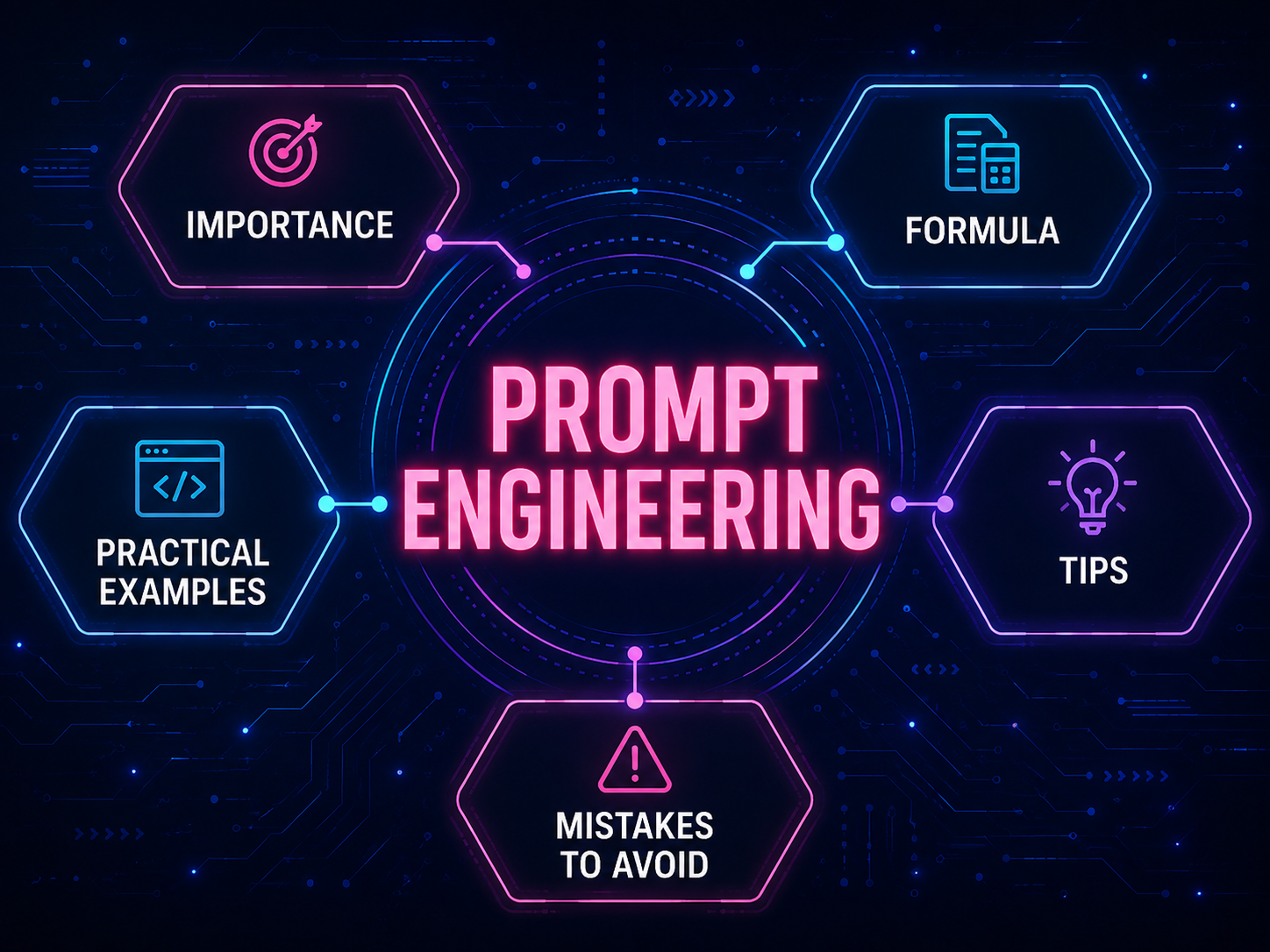
Why Is Prompt Engineering Important?
Good prompts can:
- Provide more accurate responses
- Reduce the number of follow-up questions to save time.
- Create material that is better written
- Improve the help with coding
- Assistance with education and research
- Make better photos and original concepts.
Consider it similar to giving someone directions. The result will be better if your directions are more clear.
The Formula for a Great Prompt
Typically, a helpful prompt consists of four components:
- Goal
Tell AI exactly what you want.
Example:
Write a blog post about electric vehicles.
- Context
Provide background information.
Example:
The article is for beginners with no technical knowledge.
- Constraints
Mention any restrictions or specifications.
Example:
Keep it under 600 words and use simple English.
- Output Format
Then tell clearly how you want the answer to be presented.
Example:
Make use of bullet points, headings, and a clear conclusion.
Combined prompt:
Write a 600-word beginner-friendly blog about electric vehicles in simple English with headings, bullet points and a conclusion.
Practical Examples
Example 1: Writing
Weak Prompt
Write about climate change.
Better Prompt
Write a 700-word article explaining climate change for school students. Use simple language, headings and real-world examples.
Result: More focused, structured and easier to understand.
Example 2: Learning
Weak Prompt
Teach me Python.
Better Prompt
Start from scratch and teach me Python. After each lesson, give me small practice task and explain one idea at a time using clear examples.
Result: A personalized learning as compared to an overload of data.
Example 3: Resume Improvement
Weak Prompt
Improve my resume.
Better Prompt
Improve my resume in preparation for a job as a software engineer. Strengthen action verbs, emphasize technical abilities and make it ATS-friendly.
Result: Guidance specific to a specific career target.
Example 4: Coding
Weak Prompt
Write a calculator.
Better Prompt
Create a basic Python calculator software that can perform addition, subtraction, multiplication, and division. Add comments explaining each function.
Result: Cleaner and more informative code.
Example 5: Travel Planning
Weak Prompt
Plan my trip.
Better Prompt
For a family of four, arrange an inexpensive three-day trip to Jaipur. Add well-known sights, approximate prices and suggestions for local food.
Result: A useful and personalized schedule.
Tips for Better Prompt Engineering
- Be Specific
- Give Context
- Assign a Role
- Specify the Format
Examples:
- Bullet points
- Table
- Step-by-step guide
- Blog article
- Checklist
- FAQ
- Iterate and Refine
If the first answer isn’t perfect, don’t start over.
Instead say:
- Make it shorter.
- Add examples.
- Explain in simpler language.
- Include a comparison table.
- Rewrite for beginners.
Small changes can dramatically improve the final output.
Common Mistakes to Avoid
- Using highly unclear prompts.
- Ignoring crucial context.
- Asking several irrelevant questions at once.
- Expecting AI to be aware of personal preferences without expressing them.
- Accepting the initial response without making any improvements.
Rather than being a one-time task, prompt engineering is frequently a process that is repeated.
Is Prompt Engineering Only for Experts?
Not at all.
It is used for learning by students, productivity by professionals, content creation by marketers, coding by developers and planning, writing and problem-solving by common people. Your AI experience improves as your prompts get better.
Conclusion
Prompt engineering’s goal is to communicate effectively with AI, not to memorize complicated formulas. You may unlock much more accurate and helpful responses by giving context, outlining your objective, establishing limitations and defining the preferred format. Writing effective prompts will become more and more important as AI gets more and more integrated into daily life. Adding a few extra words to your question can frequently make the difference between an average and a great response.
Read More:
- What is ChatGPT and How Does it Works?
- What is Claude AI and How Does It Work? Features, Applications & Models
- Claude AI Models Explained: Haiku, Sonnet & Opus
- AI in Education: Applications, Benefits, Challenges & Future
- AI in Healthcare: Applications, Benefits, Challenges & Future