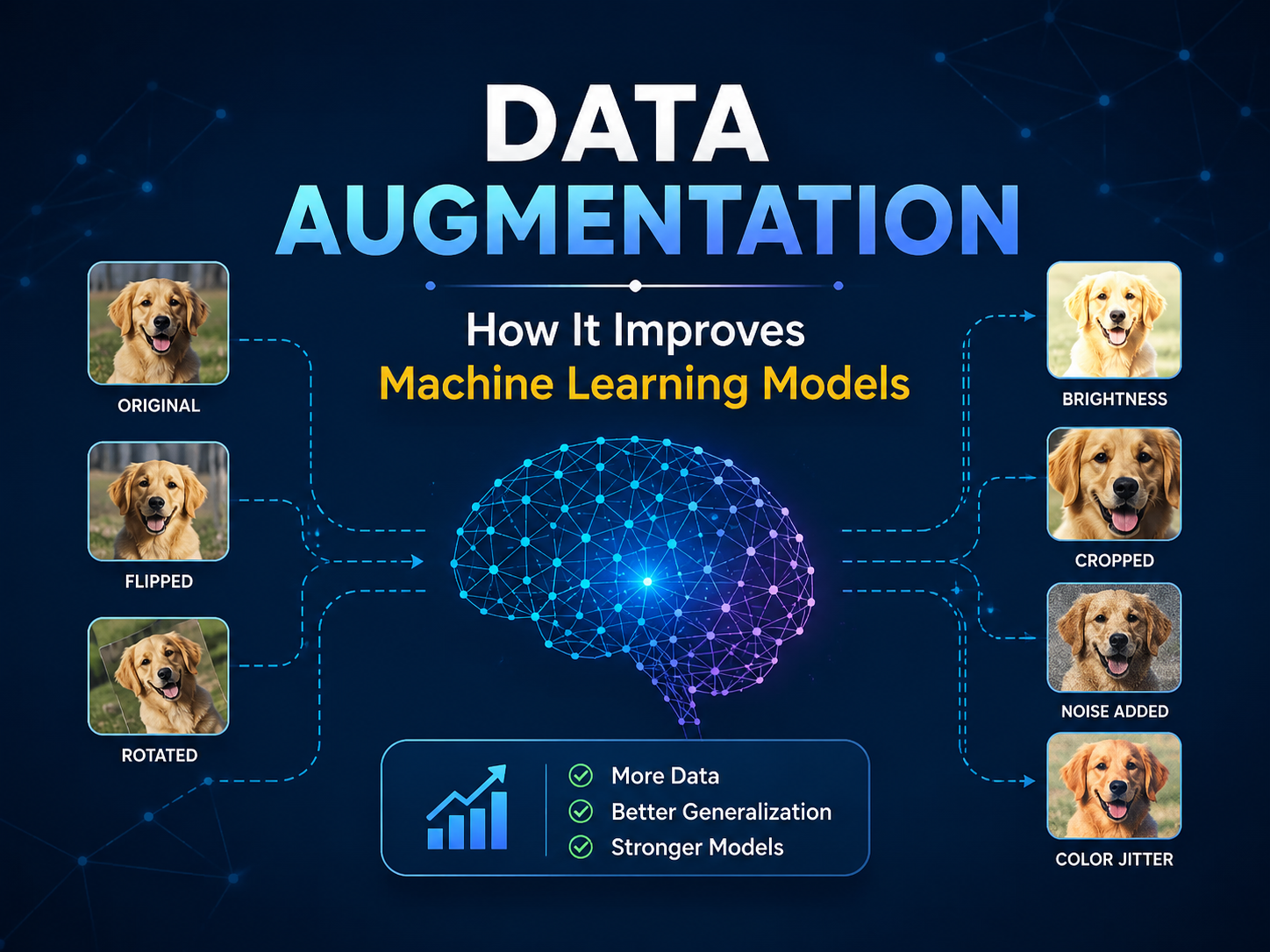
Imagine being able to make a tiny dataset appear considerably larger without having to gather thousands of new samples. That’s exactly the role of data augmentation. Augmentation generates realistic variations that expose an AI model to more options rather than repeatedly feeding it the same examples. The result? a model that can improve its adaptability, dependability and ability to handle real-world data.
Table of Contents
What is Data Augmentation?
A machine learning technique called “data augmentation” modifies existing training data while keeping its original label or meaning. Producing more data is not the only objective. In order to prevent a model from becoming overly dependent on particular patterns, it is necessary to add beneficial variation to the training dataset.
For example, when a vehicle seems slightly tilted, further distant or in changing lighting, a computer vision model that has only been trained on exact centered photos of cars may have trouble. During training, augmentation can introduce these differences and teach the model that, in spite of these changes, the item is still a car.
Why Does Data Augmentation Matter?
In general, diverse and representative training examples improve machine learning model’s performance. Large dataset collection and labelling, however, can be costly, time-consuming and challenging. By adding more variation to a given dataset, data augmentation offers an appropriate replacement.
It may benefit a model:
- Instead than learning specific cases by heart, learn more general patterns.
- Adapt to changes in the actual world
- Decrease dependence on a small dataset
- Become more adaptable to slight changes in input
- Boost generalization to previously unknown data
Basically, augmentation tells a model that the same object can exist in a variety of ways.
How does Data Augmentation Work?
The initial training dataset is typically where the procedure starts. Modified samples are then produced by applying specific changes. For example:
Original image → Rotation → Cropping → Brightness change → Augmented image
By integrating the modified samples into the training process, the model is able to view different runs of similar data.
Augmentation is often applied to training data rather than to all split datasets. In general, the real-world distribution you wish to assess performance on should be reflected in validation and test data.
Data Augmentation in Computer Vision
One of the most popular applications of augmentation is in computer vision. Consider a model that can identify traffic signs. There could be a sign:
- At different angles
- Under bright sunlight
- In poor weather
- Partially shifted in an image
- At different sizes
During training, augmentation may mimic some of these scenarios.
An image can be cropped, scaled, brightened or gently rotated. The model then discovers that these modifications do not always impact the object’s identification.
Let’s say a stop sign photo is included in an image dataset. The training process may produce versions with slightly varying rotations, sizes, lighting conditions and placements rather than just using the original image.
The model becomes less reliant on a single visual arrangement and receives several realistic perspectives of the same idea.
Data Augmentation for Text
Since altering a word can sometimes alter a sentence’s entire meaning, text augmentation is more difficult. For example:
“The product is affordable.”
The initial label might be inaccurate if affordable were changed to expensive. As a result, text augmentation must maintain context and meaning.
While trying to preserve the original intent, strategies including paraphrase, word replacement, reverse translation and regulated word alteration might produce variations.
For example:
Original: “The customer wants to cancel the order.”
Augmented: “The customer would like to cancel their purchase.”
For some NLP tasks, both statements are helpful variations because they convey nearly the same meaning.
Data Augmentation for Audio Data
Exposure to various recording situations is beneficial for audio models as well. Think of a system that recognizes speech. Someone could say:
- Quickly or slowly
- In a quiet room
- With background noise
- At different volumes
- Using different pitches
Some of these conditions can be simulated using audio augmentation.
For example, a clear speech recording can have background noise added to it. Then, even in situations where the surroundings are not entirely silent, the model can learn to identify the speaker’s words.
Data Augmentation vs Collecting New Data
Real-world data collecting is not entirely replaced by data augmentation. This difference is important.
Variations from pre-existing examples are produced by augmentation. Information that was entirely missing from the original dataset cannot be magically added. For example, rotating and cropping images of adult dogs will not produce an authentic dataset of puppies.
When the model needs to learn completely new categories, environments or scenarios, new data is still required. Combining well chosen augmentation techniques with high-quality real data is often a useful strategy.
When Should You Use Data Augmentation?
- The Dataset Is Small
A model may struggle to learn general patterns if it has few training scenarios. A thoughtfully planned augmentation can expand the range of options accessible for training.
- Overfitting Is an Issue
A model may be memorizing the training examples if it performs exceptionally well on training data but poorly on unseen data. It can be exposed to additional variants and improved generalization through augmentation.
- Real-World Data Is Highly Variable
Augmentation can help replicate changes in inputs that occur naturally due to lighting, position, noise, writing style or recording conditions during training.
How to Choose the Right Augmentation?
Not every dataset is a good fit for every transformation. The most important question is:
Would this modification actually take place in the real world while maintaining the accuracy of the original label?
For some object-recognition tasks, for example, it could make sense to flip an image horizontally. However, flipping specific text or medical images could produce incorrect data or change crucial information.
Understanding the real-world variations your model will face and choosing transformations that replicate those situations is a helpful strategy.
Common Mistakes in Data Augmentation
1.Making Use of Unrealistic Transformations
Increased augmentation may not always translate into improved performance. Examples that the model would never come across in real life can be produced using extreme modifications.
2. Modifying the Data’s Meaning
In general, an augmentation method should maintain the right label. The model may learn the incorrect thing if the transformation modifies the fundamental meaning.
3. Inaccurately Augmenting Test and Validation Data
Evaluation datasets should offer a reliable assessment of the model’s performance on actual, unseen data. Evaluation may be misleading if aggressive training-style augmentation is applied to them.
4. Presuming Augmentation Corrects Inaccurate Data
Fundamentally poor training data cannot be made up for by data augmentation. Creating new versions of the original dataset won’t fix issues with improper labels, duplication, missing categories or significant errors.
Best Practices for Data Augmentation
- Prioritize understanding the dataset by being aware of the variations that naturally occur in the real world.
- Don’t make examples that wouldn’t happen, instead, keep changes realistic.
- Make sure the modification doesn’t alter the meaning in order to preserve the original labels.
- Moderate augmentation should be used initially and complexity should only be increased as needed.
- Analyze the results by evaluating the model’s performance prior to and following augmentation.
- Use test and validation data to assess real-world generalization while maintaining its accuracy.
- Combine augmentation with sound data standards. Accurately labelled, diversified and clean data are still crucial.
Simple Real-World Example

Consider developing an AI system that recognizes various kinds of traffic signs.
There are just so many training photos available to you. Road signs, however, can appear at various angles, distances, brightness levels and locations in real life. Augmentation can add realistic differences to the current photos rather than gathering new ones for every scenario.
As a result, the model is exposed to a greater variety of visual scenarios during training and is more likely to identify the same sign when it appears differently in real life.
Conclusion
Machine learning models severely require variance and data augmentation provides it. It can assist models in going beyond memorization and learning more broadly applicable patterns by generating realistic variations from pre-existing examples. However, rather than just producing additional data for the purpose of it, augmentation functions best when it mimics real-world settings. In AI, sometimes having more data is not as useful as having smarter data.
FAQs
Q.1 What is data augmentation in machine learning?
A method called “data augmentation” modifies pre-existing training data to make it more diverse. It can boost categorization and assist machine learning models in learning from various variants of the same kind of data.
Q.2 Why is data augmentation important for AI?
As it may reduce overfitting and strengthen AI models resistance to changes in real-world data, data augmentation is crucial. It is particularly helpful when gathering a lot of new training data is costly or challenging.
Q.3 Can data augmentation improve model accuracy?
When the transformations used are relevant to the real-world variables the model must handle, it can increase accuracy. Augmentation does not, however, always result in increased accuracy.
Q.4 Does data augmentation only apply to images?
No, data augmentation is used for text, audio, speech and time-series data in addition to using computer vision.
Read More
- Computer Vision: How AI Makes Sense of the Visual World
- What is Deep Learning? How it Works, Key Components, Types and Applications
- Neural Networks Explained: How They Work, Types & Applications
- What Is Fine-Tuning in AI? How AI Models Learn Specialized Tasks
- What is Natural Language Processing (NLP)? Working, Applications & Real-World Examples