
Imagine a camera that can do more than just take pictures. For example, it could read a document, identify a face, identify a person on foot or identify a flaw in a product. Computer vision, a subfield of artificial intelligence that enables machines to understand visual data, makes this possible. It is quietly entering into everyday life of a human being, from self-driving cars to smartphones and medical devices.
Table of Contents
What is Computer Vision?
A branch of artificial intelligence (AI) called computer vision makes it possible for computers to understand and decode information from pictures, movies and other visual data.
When presented with an image, humans are able to identify items, persons, colors, movements and surroundings with ease. By analyzing visual data using algorithms, machine learning and particularly deep learning models, computer vision seeks to offer machines a similar ability.
For example, computer vision assists in determining if the face in front of the camera matches the stored facial features when a smartphone uses facial recognition to unlock the device.
How does Computer Vision Works
In order to transform raw visual data into meaningful knowledge, a computer vision system often follows a set of procedures.
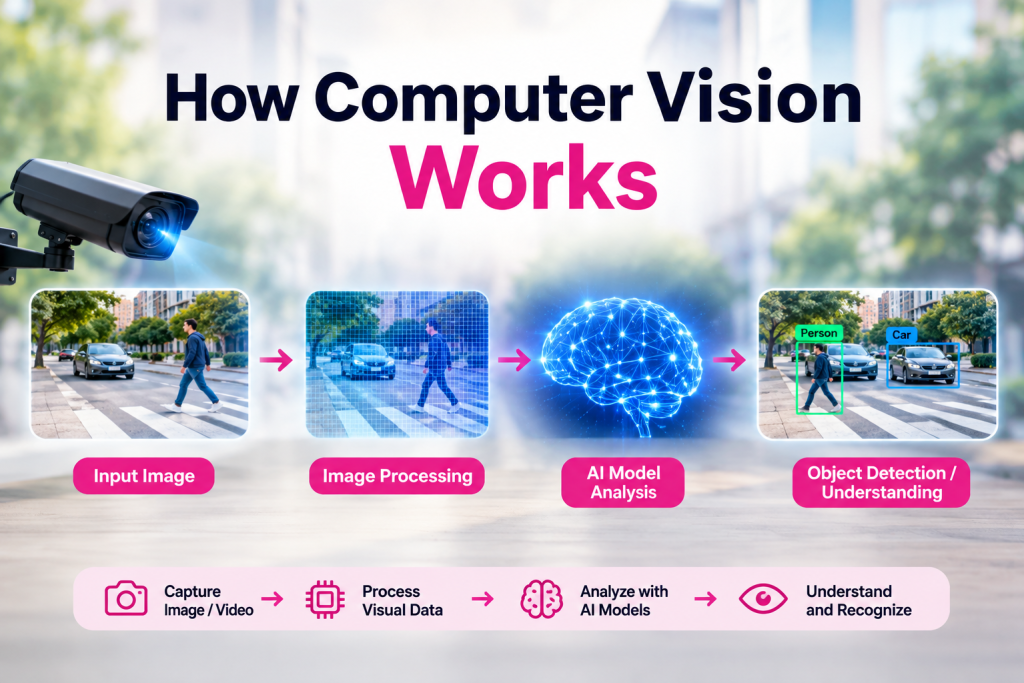
- Image or Video Capture
Visual data gathered by cameras, smartphones, scanners, medical imaging equipment, satellites or other sensors is the first step in the process. A security camera, for example, continuously records footage that may be examined to identify people or strange activity.
- Image Processing
Noise, poor lighting or irrelevant details could be present in the recorded data. By modifying elements like brightness, size, contrast or sharpness, image processing techniques may improve the input. As a result, the system operates with clearer and more valuable visual data.
- Feature and Pattern Detection
The algorithm searches the visual data for significant patterns. These could comprise edges, forms, textures, colors or more complex patterns, depending on the task. Many of these helpful features can be automatically learned by modern deep learning models, saving developers from having to clearly define each feature.
- Recognition and Interpretation
The system then interprets the visual data using an AI model that has been developed. It might identify:
- An individual
- A car
- A dog
- A sign for traffic
- A number written by hand
- A product that is damaged
What the computer vision system was trained to identify determines the result.
Applications of Computer Vision
Healthcare
Medical images from CT, MRI and X-ray scans can be analyzed by computer vision to help find patterns that might need more investigation.
Self-Driving Cars
To identify cars, pedestrians, road markings, traffic signs and other objects, self-driving and driver-assistance systems rely on cameras and vision models.
Retail
Vision systems can be used by retail companies for product recognition, checkout automation, inventory monitoring and shop analytics.
Agriculture
Using photos taken by cameras or drones, computer vision can assist with crop monitoring, disease detection, weed detection and plant growth assessment.
Production
Computer vision can be used by factories to inspect items for flaws including scratches, cracks and missing parts.
Technologies Behind Computer Vision
Deep learning and machine learning are key components of modern computer vision.
The Convolutional Neural Network (CNN), which has long been used extensively for image analysis, is one of the most significant technologies. They are able to identify more complex characteristics by learning visual patterns.
These days, computer vision increasingly makes use of alternative architectures, such as multimodal AI models and Vision Transformers (ViTs). These models have the ability to evaluate visual data and in some situations, link it to text or other kinds of information.
The capacity to train more advanced vision models has also been made possible by the availability of massive datasets and powerful computing hardware.
Benefits and Challenges of Computer Vision
Benefits
- Automation: Eliminates the need for human labor in visual inspection and analysis.
- Speed: Considerably quicker than humans at processing vast volumes of visual data.
- Consistency: When properly trained, consistently completes repetitive visual tasks.
- Scalability: Able to examine visual data from thousands or millions of photos.
- Real-time decision-making: Capable of processing video streams fast enough for uses like security monitoring and driver assistance.
Challenges
- Recognition may be challenging if the data is of poor quality. Accuracy can be lowered by dim lighting, hazy photos, odd viewpoints and partially invisible objects.
- Training data presents another difficulty. Large, different and accurately labelled datasets are typically required for AI models to function consistently.
- Concerns about privacy and security may also arise from computer vision systems, especially when they are used for large-scale surveillance or facial identification.
- Lastly, human monitoring is crucial in sensitive applications since even very good models can occasionally produce inaccurate predictions.
Conclusion
With the use of computer vision, machines are able to decode meaning from the visual environment and transform pixels into judgements and usable information. Its uses are already broad, ranging from identifying items in a picture to helping physicians and driving autonomous cars. Computer vision will continue to be a crucial technology for creating systems that can engage with their surroundings more intelligently as AI models advance.
FAQs
Q.1 What is computer vision in AI?
A subfield of artificial intelligence called computer vision makes it possible for computers to evaluate and understand visual data, including images and movies.
Q.2 What applications does computer vision have in daily life?
Smartphone face unlocking, photo organizing, security cameras, document scanning, driver-assistance systems and image search are just a few of the applications that use computer vision in daily life.
Q.3 What distinguishes image processing from computer vision?
While computer vision focuses on understanding what the images include and extracting relevant information, image processing is mostly concerned with improving or modifying images.
Read More
- Neural Networks Explained: How They Work, Types & Applications
- What is OCR? How Optical Character Recognition Works & Its Applications
- What is AI Inference? How AI Models Make Predictions
- AI in Healthcare: Applications, Benefits, Challenges & Future
- What Is Fine-Tuning in AI? How AI Models Learn Specialized Tasks