Imagine using the internet to send a private message. Before it reaches the recipient, it passes through servers, networks and other devices. How, then, can it stay unclear to anyone who could intercept it?
Encryption is useful in this situation. Symmetric and asymmetric encryption are two key cybersecurity strategies. They both use keys to protect data but they do it in fundamentally different ways, which helps to explain how secure internet communication operates.
Table of Contents
What is Symmetric Encryption?
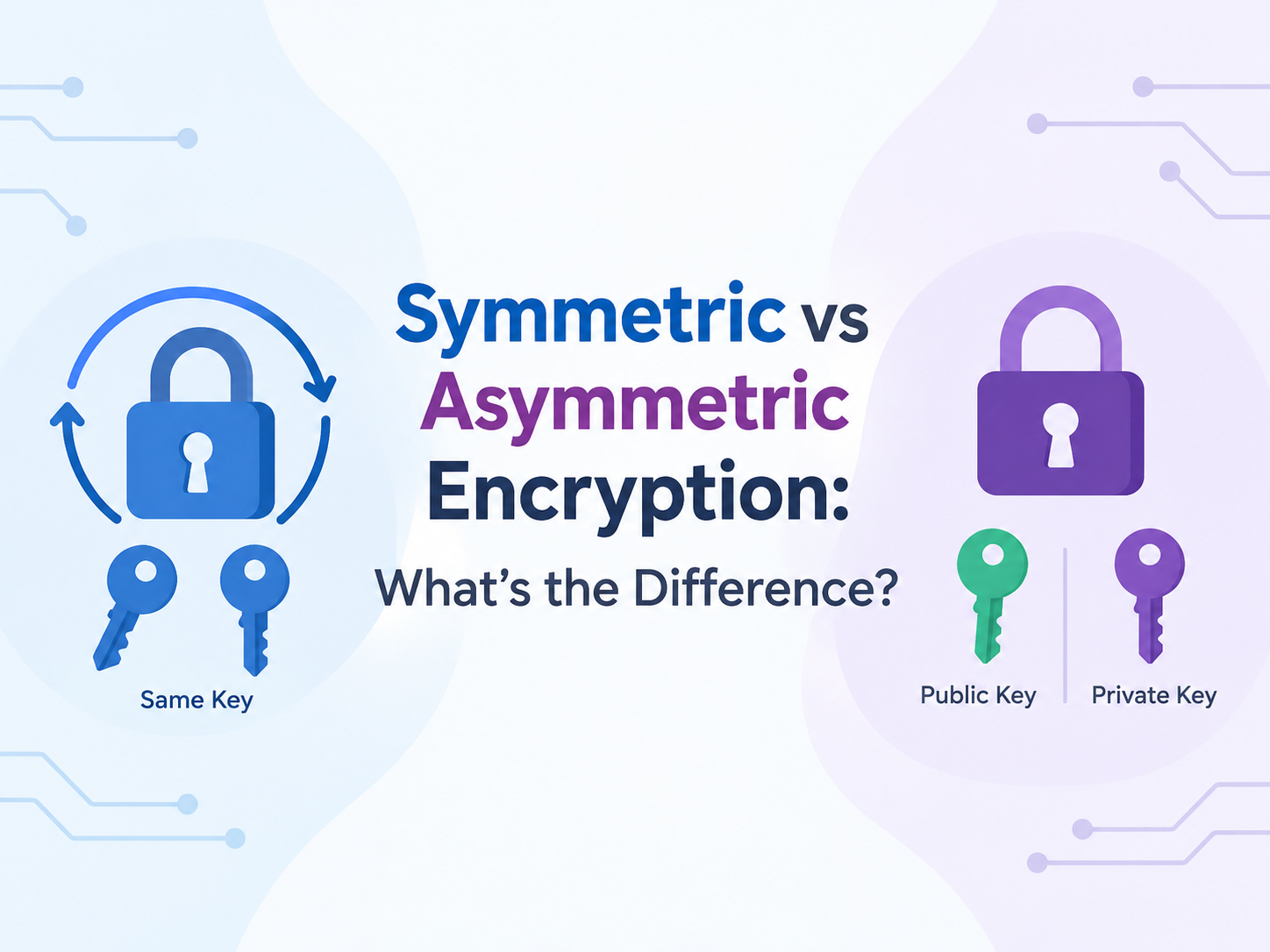
Symmetric encryption encrypts and decrypts data using a single secret key. Imagine it as a locked box. The receiver needs the same key to open the box that you used to lock it. The process is simple:
Plaintext → Encryption + Secret Key → Ciphertext → Decryption + Same Key → Plaintext
Let’s take an example where Alice wishes to send Bob a private document. she uses a secret key to encrypt the file. Bob then decrypts and reads the file using the same key.
Speed is symmetric encryption’s greatest benefit. It is helpful for files, databases and network communication since it can effectively encrypt and decrypt vast volumes of data.
But there is a significant issue:
How can Alice provide Bob the secret key in a secure manner?
An attacker could be able to decode the protected data if the key is intercepted during sharing.
Typical Symmetric Encryption Techniques
The following are a few popular symmetric encryption algorithms:
- AES (Advanced Encryption Standard)
- ChaCha20
Sensitive data is frequently protected with AES in modern computer systems.
What is Asymmetric Encryption?
Asymmetric encryption operates in a different way. It uses two mathematically related keys in place of a single shared key:
- Public key- freely accessible
- Private key- needs to be kept confidential
Consider the public key as a lock that anybody may use to secure a box and the private key as the sole way to open it.
This is how an easier encryption procedure appears:
Plaintext → Public Key → Ciphertext → Private Key → Plaintext
Bob, for example, is able to give everyone access to his public key. Alice can encrypt data meant for Bob using his public key. Bob then decrypts it using his private key. Bob never needs to get a secret encryption key from Alice through the network.
Due to this, asymmetric cryptography is particularly helpful for digital signatures, safe key exchange and authentication.
Typical Asymmetric Techniques
Examples consist of:
- RSA
- ECC (Elliptic Curve Cryptography)
Although asymmetric cryptography offers significant security benefits, it is typically slower and more computationally costly than symmetric encryption.
Symmetric vs Assymmetric Encryption
| Parameters | Symmetric Encryption | Assymmetric Encryption |
|---|---|---|
| Keys Used | One Key | Two Keys |
| Keys | Same Secret Key | Public + Private Key |
| Speed | Faster | Slower |
| Key Sharing | More Challenging | Easier |
| Large Data Encryption | Well Suited | Less Efficient |
| Uses | Data Encryption, Storage, Network Sessions | Key Exchange, Authentication, Digital Signatures |
How are Symmetric and Asymmetric Encryption Used Together?
This is the most interesting part.
You might think that symmetric or asymmetric encryption is the only option available for safe systems. In reality, both can be used in modern secure communication since they each address distinct issues.
Think about what occurs when you use HTTPS to connect to a website.
Asymmetric cryptography can be used to establish secure session settings and assist with authentication during connection setup. Since symmetric cryptography is much faster, it is usually used to protect the actual data being sent once a secure connection has been created.
To put it simply:
- Asymmetric encryption: Build confidence and protect the session configuration.
- Symmetric encryption: Effectively secure the conveyed data
Modern systems benefit from both security and performance due to this combination.
Where is Symmetric Encryption Used?
When a lot of data needs to be quickly protected, symmetric encryption is especially helpful. Few examples include:
- File encryption
- Database encryption
- VPN traffic
- Cloud data protection
- Secure network communication
- Encrypted storage
For example, it is far more feasible to encrypt a huge file using a symmetric technique rather than encrypting each section of the file asymmetrically.
Where is Asymmetric Used?
When two parties need to build confidence without already sharing a secret key, asymmetric cryptography is particularly helpful. It is used in:
- Secure key exchange
- Digital signatures
- Authentication
- HTTPS/TLS
- Secure email
- Identity verification
Another crucial application is digital signatures. Asymmetric cryptography can assist in proving who authorized or originated a message and whether it was altered as opposed to encrypting it for secrecy.
Which One is Better?
Neither is simply “better.”
As symmetric encryption is quicker, it is a great option for protecting massive volumes of data.
Asymmetric encryption is useful when parties need to securely communicate without already sharing a secret key since it resolves significant key-management and authentication issues.
Due to this, contemporary cybersecurity systems frequently use both strategies rather than just one.
Consider it this way:
- Speed equals symmetric encryption.
- Secure key management and authentication are achieved by asymmetric encryption.
When combined, they make up a significant portion of the technology that ensures the security of digital communication.
Conclusion
The fundamental concept behind encryption is surprisingly simple: transform readable data into something that unauthorized individuals cannot decipher. While asymmetric encryption uses a public-private key pair to address issues like secure communication and authentication, symmetric encryption achieves this effectively with a single shared key. In the actual world, the two frequently combine to provide us with the speed and security required for today’s internet.
Read More
- What is Authentication? Types, Techniques and Applications
- What is a VPN? How It Works, Benefits & Why You Need One
- TCP vs UDP: Key Differences, Uses, and How They Work
- What Is an API? How APIs Work and Why They Matter
- What Is Cyber Security? Types, Threats and Best Practices