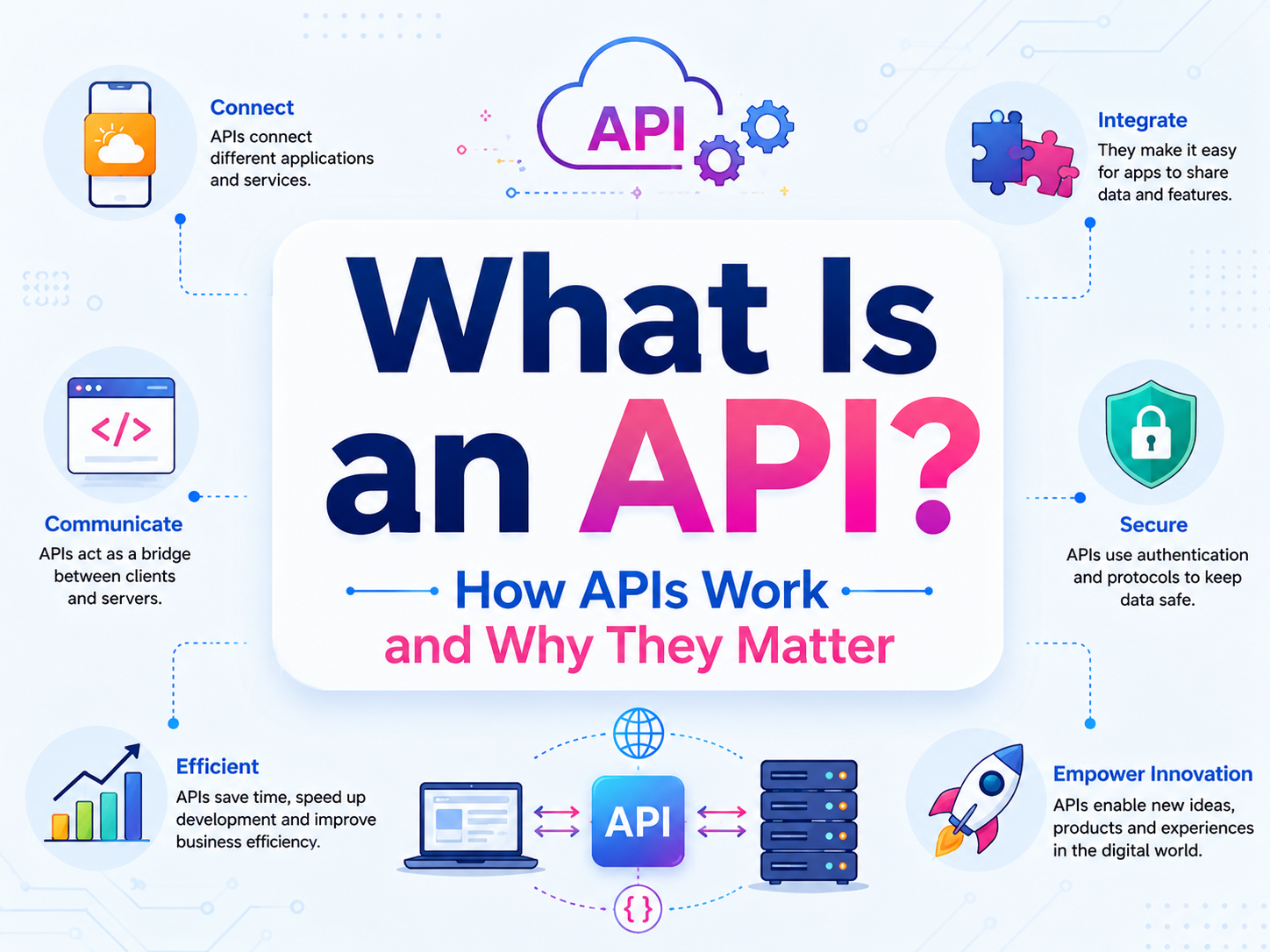
Every time you check the weather, log in with Google, pay through an online payment gateway, or ask an AI chatbot a question, it is working behind the scenes. APIs are among the most significant technologies driving the modern internet, despite the fact that most people never see them. They provide seamless task execution, data sharing and communication between various software programs. Anyone interested in learning how today’s digital services operate can benefit from an understanding of APIs, not just developers.
What is an API?
API stands for “Application Programming Interface”. It is a set of rules and protocols that allows different software applications to communicate with other applications. Instead of one application directly accessing another program’s internal code or database, it submits a request through an API and receives the requested information or service in return.
For example, imagine an API in ordering meals at a restaurant. The person tells the waiter what you want, the waiter delivers the request to the kitchen and then brings food back to them. It is never necessary for that person to understand how the food is prepared in the kitchen. Basically, an API functions as a mediator between two software systems, managing requests and sending results without disclosing the complex processes that was happening behind the scenes.
How Does an API Work
An API follows a request-and-response model. Here’s how the process normally works:
- The customer sends a request.
- A user performs an action such as opening a weather app or clicking a purchase button. The program sends an API request providing the requested information.
- The API receives the request.
- The request’s validity and the application’s authorization to access the resource are verified by the API.
- The server processes the request.
- The API forwards the request to the proper server or database where the required operation is performed.
- The API returns the response.
- The server delivers the result back through the API and the application shows the information to the user.

For example, the weather app transmits your location to a weather service API when you look up the current weather. The app displays the findings in a matter of seconds after the API obtains the most recent prediction from the weather server.
APIs Types
- Open APIs (Public APIs)
Although many open APIs require an API key or registration, anyone can use them. Businesses frequently provide them to draw developers to use their services to create applications.
- Partner APIs
Only authorized business partners are granted access to partner APIs. They limit access to authorized individuals while enabling safe collaboration across organizations.
- Private APIs
Internal use within an organization is the purpose of private APIs. They allow effective communication between several departments or internal apps without exposing services to outside developers.
- Composite APIs
Multiple API requests are combined into a single call using composite APIs. Developers can retrieve numerous pieces of information at once rather than submitting multiple individual queries, which improves performance and lowers network traffic.
Examples of APIs
- Weather service APIs are used by weather apps to obtain real-time weather information.
- Google Maps APIs give mobile apps and websites access to maps, navigation and location services.
- APIs are used by payment gateways like PayPal and Stripe to safely handle online transactions.
- Authentication APIs are used to confirm user identities when logging in with Google or Facebook.
- Using APIs, social media platforms enable apps to share posts, pictures or videos.
- Developers are able to integrate chatbots, text production, image creation, speech recognition and language translation into their programs with the help of AI services APIs.
Why APIs Matter
- Quicker Development: Instead than creating every feature from scratch, developers can integrate pre-existing services, saving time and money.
- Simple Integration of Applications: APIs provide seamless data exchange across various software systems, regardless of the programming languages or technologies used in their development.
- Promotes Innovation: By merging several APIs, businesses can produce completely new products, resulting in quicker innovation and more powerful digital services.
- Improved User Experience: Without having to transfer between platforms, users can access several services from a single application.
Common API Protocols and Format
- REST API
The most used API design is REST (Representational State Transfer). It operates via common HTTP methods including GET, POST, PUT and DELETE and is scalable and lightweight.
- GraphQL
GraphQL minimizes needless data transfer and boosts efficiency by enabling clients to request only the accurate data they require.
- SOAP
An older messaging system called SOAP (Simple Object Access system) is renowned for its strict rules and excellent security. Banking, healthcare and corporate systems continue to make extensive use of it.
- JSON
The most popular data format used by current APIs is JSON (JavaScript Object Notation). It is lightweight, simple for apps to process and easy for people to read.
- API Security
Securing APIs is crucial since they frequently handle sensitive data. Typical security precautions consist of:
- API Keys: Identify the application submitting the request using API keys.
- Authentication: Before allowing access, it confirms the identity of users or apps.
- Authorization: Establishes the resources that a user who has been verified can access.
- HTTPS Encryption: Data is encrypted during transmission between the client and the server using HTTPS encryption.
- Rate Limiting: To minimize abuse and guarantee equal usage, it limits the quantity of requests made within a given time frame.
Challenges of APIs
- Risks to Security: APIs with poor security may reveal private data or become targets of hackers.
- Version Compatibility: Older apps may stop functioning when an API is upgraded if developers don’t adjust to the new version.
- Downtime: Dependent apps may stop working until the service is restored if an API provider has outages.
- Rate Limits: High-traffic applications may be impacted by the fact that many APIs limit the number of queries users can submit in a particular time frame.
- Insufficient Records: It is more difficult for developers to understand and properly integrate an API when the documentation is out-of-date or incomplete.
Conclusion
APIs are the hidden connectors that enable the modern digital world. They provide fast, safe and effective communication across software systems from mobile apps and online payments to cloud services and artificial intelligence. APIs will continue to be at the center of innovation as technology develops, allowing developers to create more intelligent applications and providing seamless experiences that customers depend on on a daily basis.
FAQs
- Are APIs safe?
Yes, when they use measures like rate restriction, HTTPS encryption, authorization, authentication and API keys, APIs may be quite secure. However, security issues may be revealed by poorly built APIs.
2. Is programming knowledge necessary for APIs?
As developers must send queries and evaluate results, using an API typically involves some programming experience. However, a lot of low-code and no-code platforms also offer tools for integrating APIs with little to no coding.
3. Is it possible for a single application to use several APIs?
Indeed. Many modern applications make use of several APIs at once. For example, a food delivery service might use a messaging API to provide delivery updates, a payment API for transactions and Google Maps for navigation.
Read More:
- What Is Cloud Computing? How It Works, Types, Benefits & Examples
- What is AI Product Management? Roles, Skills and career Guide
- What is OCR? How Optical Character Recognition Works & Its Applications
- What Is a Vector Database? How AI Stores and Retrieves Information
- What is Retrieval-Augmented Generation (RAG)? How It Makes AI More Accurate
Leave a Reply