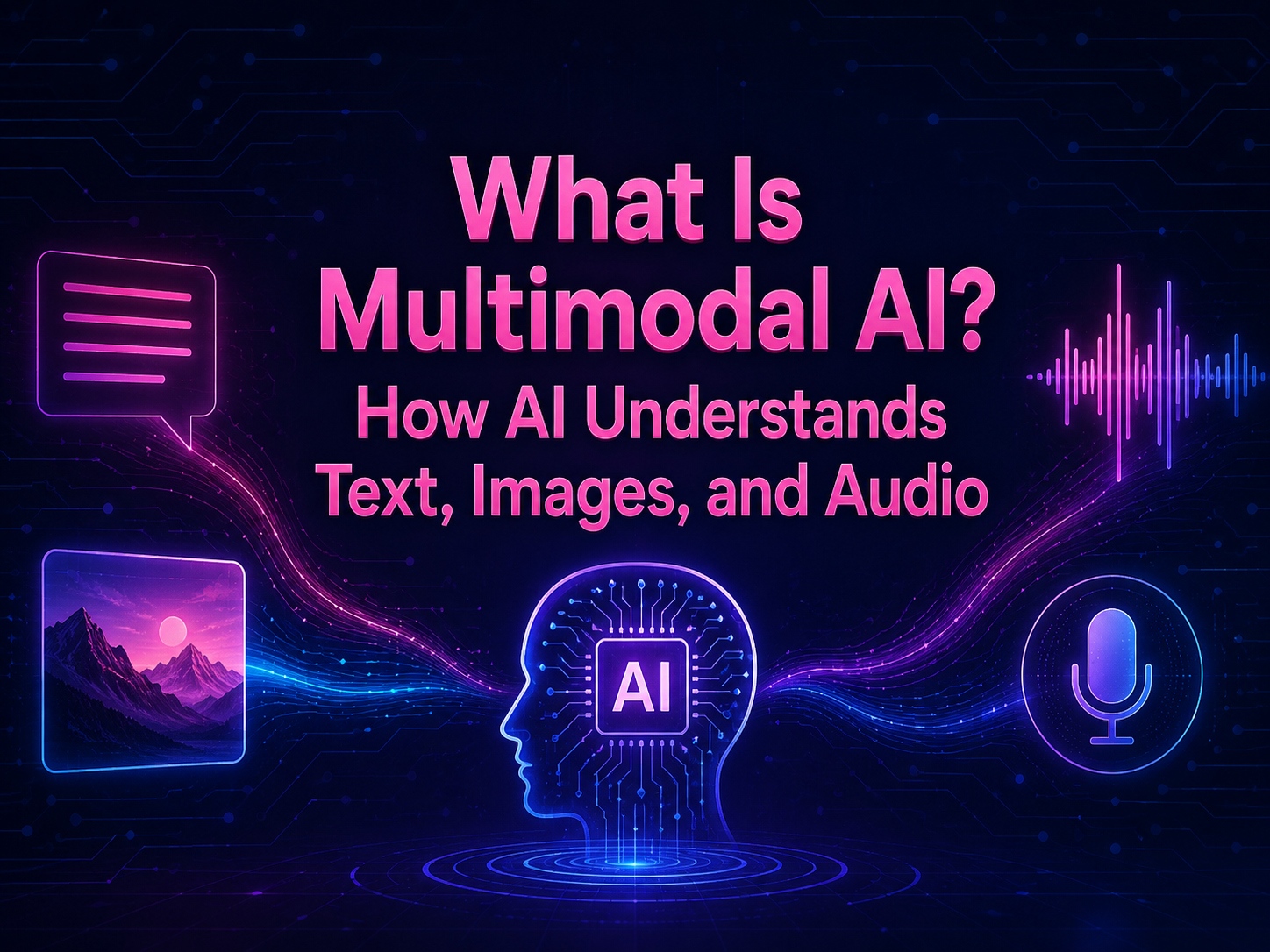
Artificial intelligence has advanced well beyond text-processing algorithms. A variety of information forms, including text, photos, music and even video, may now be understood and used by modern AI models. Multimodal AI is the term for this functionality and it can analyze data more like humans by merging many data formats, producing outputs that are more accurate, context-aware and practical. It is emerging as a crucial technology driving many current AI applications, from chatbots that analyze visuals to virtual assistants that understand spoken commands.
What is Multimodal AI?
A type of artificial intelligence called as multimodal AI is capable of processing, understanding and producing information from various data types or modalities. Among these modalities are:
- Text
- Images
- Sensor data
- Audio
- Video
Multimodal AI integrates data from several sources to better understand the input and deliver more relevant answers as compared to traditional AI systems that focus on a single data type.
For example, if you post a picture of a car that has been damaged and ask, “What happened here?”. In order to provide a well-informed response, a multimodal AI system can examine both your text query and the image.
How Multimodal AI Works?
- Processing of data
First, every kind of data is transformed into a format that AI models can understand.
- Tokens are created from text.
- Visual characteristics and numerical pixel representations are created from images.
- Spectrograms or waveforms are created from audio.
This procedure makes it possible to numerically express various kinds of information.
- Feature Extraction
Important patterns are extracted from each modality using specialized neural networks.
For example:
- Relationships between words are identified using language models.
- Vision models identify scenes, colors, shapes and objects.
- Speech, noises and tone are all recognized by audio models.
Embeddings, which are numerical representations that convey meaning are created from the retrieved data.
- Fusion of Information
The AI creates a shared representation by combining data from several modalities. The model may link data from various data kinds due to this phase.
For example:
- The phrase “golden retriever” can be related to an image of a dog.
- It is possible to link spoken words to their printed version.
- Sounds that are happening simultaneously can be linked to video frames.
The model then generates answers, predictions, or actions based on this combined information.
How AI Understands Text?
Large language models (LLMs) are commonly used to enable text understanding.
These models learn the following after being trained on vast volumes of written content:
- Sentence structure and grammar
- Meanings of words
- Relationships and context
- The purpose of the questions
Modern AI predicts and recognizes patterns of speech rather than just matching keywords. This enables it to produce human-like responses, translate languages, summarize content and respond to enquiries. Text is frequently the main way users engage with AI in multimodal systems.
How AI Understands Images?
AI combines computer vision methods and neural networks that have been trained on millions of visual examples to understand images.
The AI gains the ability to recognize:
- Faces
- Colors
- Shapes
- Locations
- Activities
For example, the model might identify a road, a bicycle and a person riding it while examining a picture. After then, it integrates these observations to fully understand the scene as it is. Additionally, an advanced multimodal systems can link language and visual content, enabling users to ask questions about images or get full explanations of them.
How AI Understands Audio?
Processing sound waves and transforming them into patterns that machine learning models can examine is the process of audio understanding.
AI is able to identify:
- Words spoken
- Features of the speaker
- Feelings in speech
- Background noises
- Patterns in music
While audio analysis models detect additional context-specific data like tone, volume, and background sounds, speech recognition systems translate spoken language into text. Applications like voice assistants, transcription software and real-time translation systems are made possible by this.
Why Combining Text, Images and Audio Matter?
Every modality offers different information. Take a video conference recording, for example:
- The spoken words are provided through text transcripts.
- Tone and intensity are captured using audio.
- Video frames display actions and facial expressions.
AI obtains a far deeper knowledge than it would from any one source alone when it examines all of these inputs collectively.
AI benefits from this multimodal approach:
- Cut down on miscommunications
- Boost accuracy
- Gain a deeper understanding of context
- Increase the simplicity of interactions
The end product is a system that can produce more beneficial answers and make better decisions.
Applications of Multimodal AI
- AI Virtual Assistants and Chatbots: Modern AI assistants provide natural user interaction across a variety of channels due to it’s ability to analyze text, voice instructions and the images.
- Image Captioning: AI can improve accessibility for those with vision problems by automatically producing the explanations of images.
- Healthcare: To help with diagnosis and treatment choices, doctors can integrate voice notes, medical imaging and patient records.
- Self-Driving Cars: To understand their environment, self-driving cars continuously examine sensor data, audio signals, maps and camera feeds.
- Education: AI-powered learning platforms can integrate written materials, visual images and spoken explanations, offering more interactive learning experiences.
Challenges of Multimodal AI
- Complexity of Data: Integration is challenging since different modalities have different styles and frameworks.
- Requirements for Computation: It takes a lot of processing power and storage to process text, music and images all at once.
- Data Alignment : When matching spoken words to certain visual occurrences, for example, the model must accurately connect information across modalities.
- Accuracy and Bias: The system’s total performance may be impacted by biases or errors in a single data source.
- Privacy Issues: Strong privacy controls are necessary because multimodal systems frequently handle sensitive data, including voice recordings and images.
Future of Multimodal AI
Future multimodal AI systems will probably be able to reason and plan across various inputs in addition to simply understanding facts. They could include real-time sensory data from IoT devices, allowing for continuous awareness of settings like smart homes and cities. Stronger personalization, in which AI deeply adjusts to individual behavior across speech, visuals and interaction history, is another possibility. Low-resource multimodal AI, which makes these systems quicker and mobile-friendly, is another important area. Lastly, as these systems handle increasingly sensitive, real-world data, ethical AI frameworks will become essential.
Conclusion
Multimodal AI represents a major step toward creating AI systems that understand the world more like humans do. These algorithms can collect deeper information and produce more accurate results by integrating text, images and audio. Multimodal AI is already revolutionizing a number of industries, from content search and driverless cars to virtual assistants and medical equipment. It is expected that as technology develops further, it will become more crucial to the next generation of intelligent systems.
Read More:
- How AI Chatbots Work: Behind the Technology
- What Are Large Language Models (LLMs) and How Do They Work?
- AI Hallucinations: Why AI Makes Mistakes
- AI vs Machine Learning vs Deep Learning: What’s the Difference?
- What Are AI Agents? How Autonomous AI Systems Work
Leave a Reply