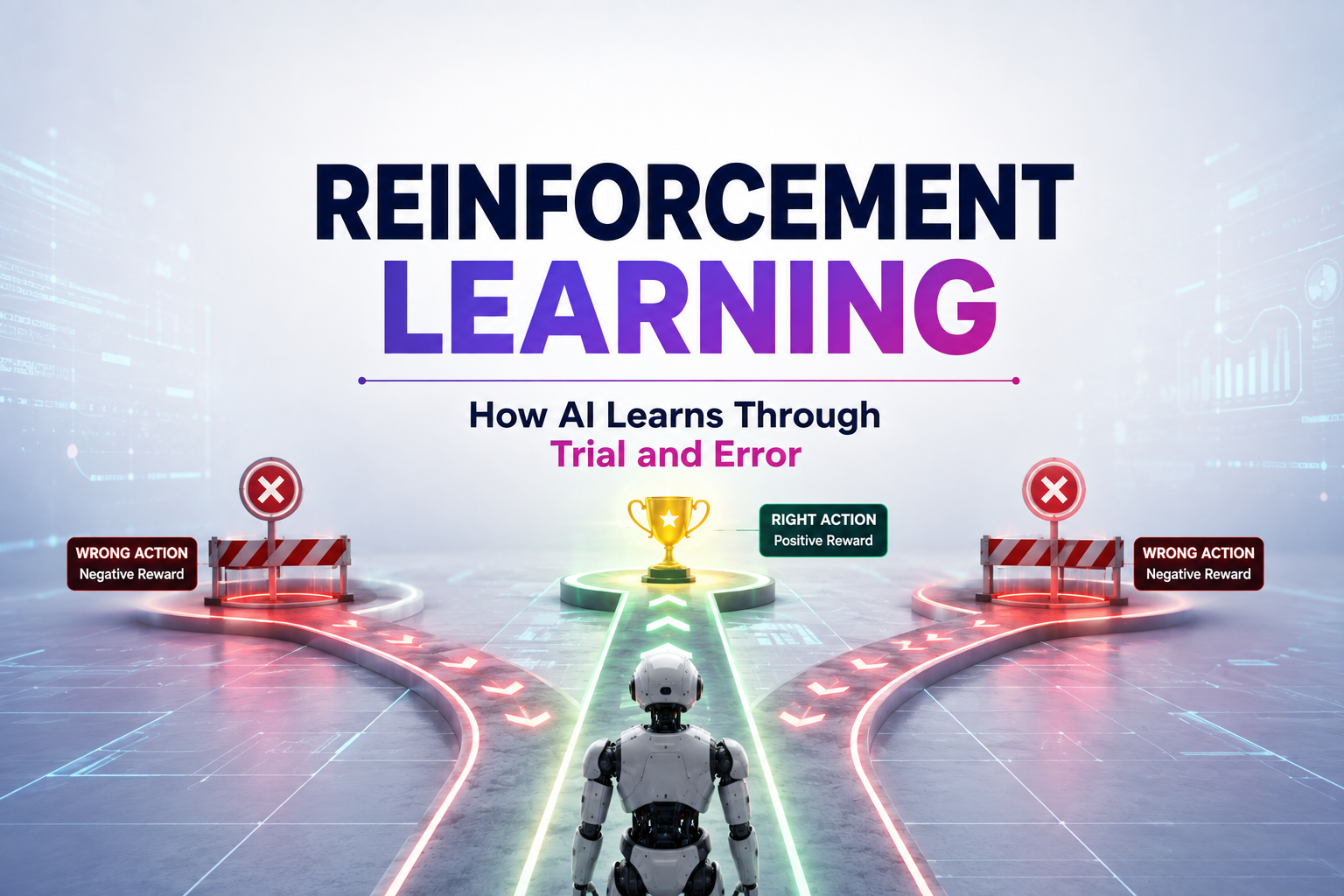
Without clear instructions, how can an AI learn to make better decisions? Through experience, feedback and repeated interaction with their environment, computers can learn via Reinforcement Learning (RL). This system determines which activities result in better outcomes rather than learning from labelled answers. It assists machines in making increasingly intelligent judgements, from robotics and autonomous systems to game-playing AI.
Table of Contents
What is Reinforcement Learning?
An AI agent can learn how to make decisions by interacting with its surroundings and getting feedback for its activities and this process is known as reinforcement learning.
The right response isn’t always provided to the system. Rather, it experiments with various behaviors and is rewarded for good behavior or punished for bad behavior. It eventually picks up a strategy that maximizes its overall return.
A robot learning to get to a location is an easy example. It might get a favorable reward if it goes in the correct way. It could be rewarded negatively if it encounters an obstacle. The robot may discover which moves work best after several tries.
This learning process is commonly described as trial and error.
How does Reinforcement Learning Works?
The core of reinforcement learning is an agent’s constant communication with its surroundings. This process works like this:
- The state or current situation is observed by the agent.
- Based on its current plan, it selects a course of action.
- That action causes the environment to react.
- The agent is either rewarded or penalized.
- Based on the result, the agent modifies its plan.
- Until the agent improves in accomplishing its goal, the cycle keeps on.
Consider an AI that learns to play a racing game. The position and speed of the vehicle could be included in the state. The AI selects a course of action, like turning or accelerating. While crashing could result in a penalty, staying on the track might result in a good reward. The AI improves its driving skills after several tries.
Key Components of Reinforcement Learning
- Agent
The learner or decision-maker is the agent. It watches its surroundings, makes decisions and gains knowledge from the results of those decisions. Examples include a game-playing AI, robot, or autonomous vehicle.
- Environment
Everything the agent comes into contact with is part of the environment. It reacts when the agent takes action and gives details about the present state of events. For a robot, the physical world can be its environment. For a game-playing AI, the game itself is the environment.
- State
From the agent’s point of view, a state depicts the current state of the environment. For example, the condition of the current state of a chess game is represented by the arrangement of pieces on the board.
- Action
A decision the agent can make in a specific state is called an action. A robot may turn left, right, forward or backward. An AI that plays games might select a specific action.
- Reward
Feedback that informs the agent of the value of its prior activity is called a reward. While negative rewards prevent undesirable behavior, positive rewards promote desired behavior.
- Policy
A policy specifies how an agent decides what to do depending on the state it comes across. The policy could change as learning advances to help the agent make wiser choices.
Types of Reinforcement Learning
Model-Based Reinforcement Learning
The agent in model-based reinforcement learning tries to understand or predict how the environment will react to certain behaviors. It can then use this information to make plans for the future. When the environment can be well modelled, this method can lessen the need for significant trial and error.
Model-Free Reinforcement Learning
Without intentionally creating a model of the environment, the agent learns from its experiences in model-free reinforcement learning. It focuses on identifying the behaviors that usually result in better results. This method is used by many well-known RL algorithms.
Common Reinforcement Learning Algorithms
Q-Learning
A popular model-free approach that determines the expected value of performing in a specific state is called Q-learning. The agent can use these values to evaluate which activities are most likely to result in higher long-term rewards.
SARSA
Another model-free algorithm is SARSA, which modifies its knowledge according to the state, action, reward, subsequent state and action that follows in the learning process. When an agent learns from its actual behaviors, it is especially helpful.
Q-Networks Deep (DQN)
Neural networks and Q-learning are combined in Deep Q-Networks. A neural network calculates action values rather than storing them in a standard database. DQN gained recognition for making it possible for AI systems to learn challenging gaming tasks using visual input.
Policy Gradient Methods
Policy gradient methods optimize the policy itself instead of learning the worth of individual acts. Large or continuous action space problems benefit from their use.
Real-World Applications of Reinforcement Learning
Robotics
RL can be used by robots to learn how to move, navigate, handle objects and perform other physical activities. Developers can let the robot learn useful behaviors through controlled training, rather than manually programming every scenario.
Recommendation Systems
Instead of only optimizing for a quick click, RL can assist recommendation systems in determining which items or content are more likely to produce beneficial long-term results.
Gaming
In gaming, RL has had great success. Through frequent play and performance optimization, AI agents can pick up strategies for board games, video games and simulations.
Resource Management
Reinforcement learning can be used by businesses to optimize difficult resource-related decisions including network operations, energy consumption and processing power.
Autonomous Vehicles
RL can be explored for autonomous driving decision-making tasks like movement planning and responding to changing road conditions. Safety restrictions and other methods are equally crucial in real-world systems.
Advantages of Reinforcement Learning
- Learns by performing: By engaging with its surroundings, the system can get better.
- Manages consecutive decisions: It works well in situations where a single choice has an impact on results that follow.
- Does not always require labeled datasets: The agent can learn from rewards created during contact, therefore labelled datasets are not necessarily necessary.
- Can find unexpected methods: RL agents might come up with answers that weren’t specifically designed by humans.
- Adjusts to evolving conditions: An agent can pick up methods for changing environments with the right training.
Challenges of Reinforcement Learning
RL is not appropriate for all machine learning problems, despite its potential.
Training time is a significant obstacle. Before learning a dependable approach, an agent could require a large number of sessions. When errors have practical consequences, exploration can sometimes be costly or dangerous. Reward design presents another difficulty. The agent may learn surprising behaviors while theoretically maximizing its reward if the reward function does not accurately represent the desired goal.
Significant computing resources may also be needed for RL systems, especially when deep neural networks are used.
Conclusion
AI systems can learn how to make decisions through interaction, feedback and experience due to reinforcement learning. An agent can progressively improve its methods by striking a balance between exploration and acts that have proven effective in earlier times. It is still a key strategy for creating systems that can learn how to behave as AI continues to advance into robotics, autonomous systems, gaming and complicated optimization.
Who should be familiar with this topic? Students studying AI and machine learning, aspiring AI engineers, robotics geeks and anybody else interested in learning how machines can learn to make decisions instead of just making predictions will find reinforcement learning very helpful.
FAQs
Q.1 What is reinforcement learning?
An AI learns through reinforcement learning, a machine learning technique in which it does various actions and is rewarded or penalized according to the outcomes.
Q.2 Is deep learning compatible with reinforcement learning?
Certainly. To handle complicated states and massive amounts of data, deep reinforcement learning blends deep neural networks with reinforcement learning.
Q.3 Does supervised learning apply to reinforcement learning?
No, different learning signals are used in supervised learning and reinforcement learning. Supervised learning learns from labelled examples, whereas reinforcement learning learns through interaction and rewards.
Q.4 Is it hard to learn reinforcement learning?
While complex RL includes ideas like value functions, policies, exploration methods and mathematical optimization, the fundamental idea is quite simple to understand.
Read More
- Introduction to Machine Learning
- Understanding Supervised Learning: Types, Algorithms, Benefits and Applications
- What is Unsupervised Learning? Types, Benefits and Applications
- Difference between Supervised Learning and Unsupervised Learning
- What is Data Annotation? Importance, Types, Tools & Platforms and Challenges
Leave a Reply