Chatbots and future robots are no longer the sole applications of AI. Intelligent systems are finding their way into everyday technology, from generative AI and autonomous agents to recommendation engines and AI assistants.
People that can really develop, integrate, implement and improve AI systems are in greater demand as a result of this. That is where AI engineers come in.
This AI Engineer roadmap breaks everything down into manageable steps if you’re wondering what to learn, where to begin and whether you need to master everything before producing something valuable.
Table of Contents
What is an AI Engineer
An AI engineer creates systems and applications that make use of machine learning and artificial intelligence. Training models, using APIs and LLMs, developing AI-powered apps, deploying models and integrating AI systems with real-world data are all possible aspects of their work.
Think of it this way:
Data → Models → AI Application → Deployment → Real-World Use
It’s not necessary to learn every AI topic at once. Building your skills layer by layer is a more intelligent strategy.
AI Engineer Roadmap
The general learning path is as follows:
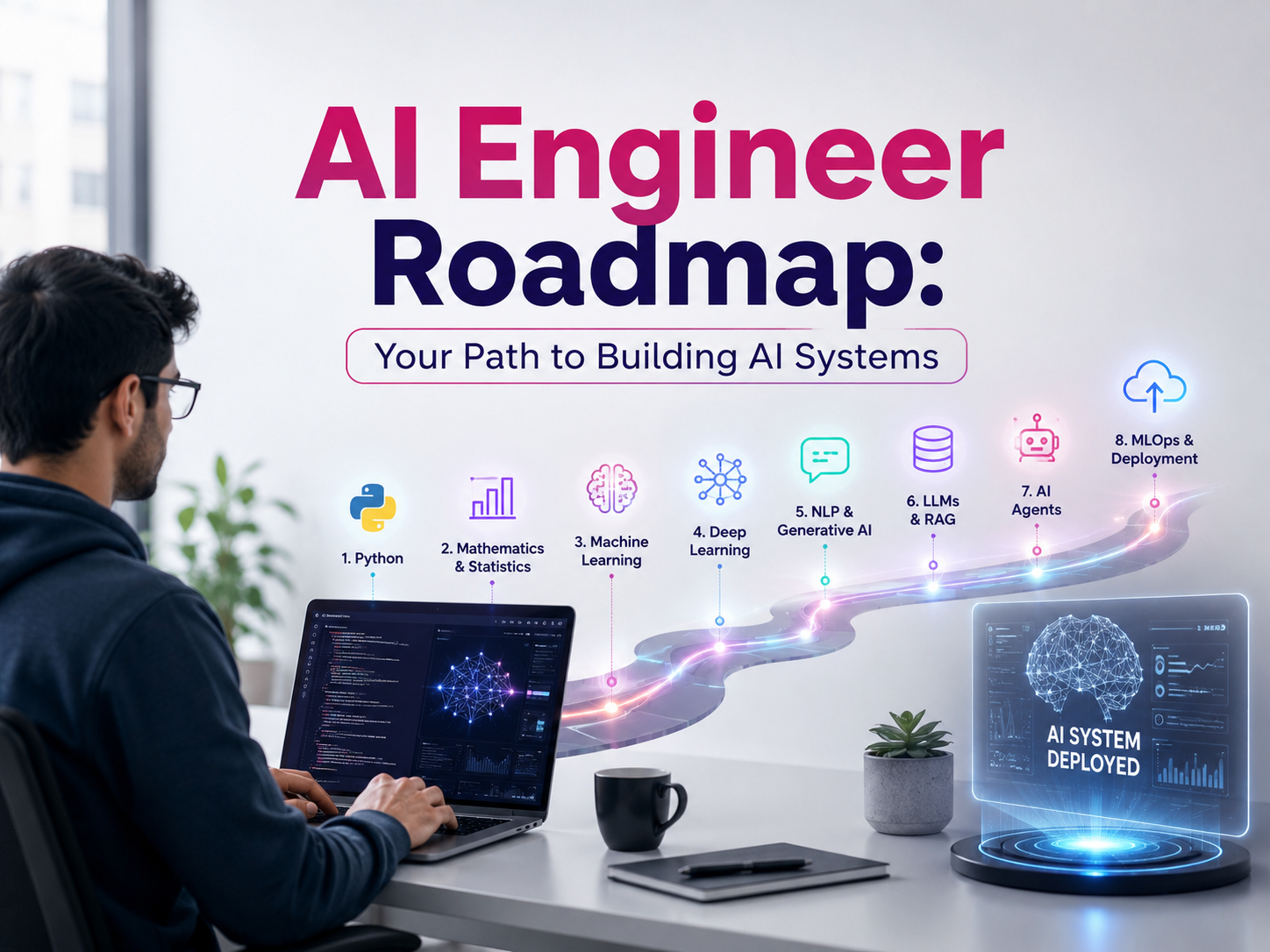
Python → Mathematics → Machine Learning → Deep Learning → NLP & Generative AI → LLMs & RAG → AI Agents → MLOps & Deployment → Practical Projects
You are not required to stick to this path strictly. You can begin developing projects before they reach the final level and some concepts overlap.
- Learn Python First
One of the most crucial programming languages for machine learning and artificial intelligence is Python.
Before diving into advanced AI, prepare yourself with:
- Variables and data types
- Conditional statements and loops
- Functions
- Lists, tuples, dictionaries and sets
- Object-oriented programming
- File handling
- Exception handling
- APIs and JSON
- Basic data structures
Additionally, you should familiarize yourself with libraries like Matplotlib, Pandas, and NumPy. To interact with AI, you don’t have to be an expert in Python. Writing and understanding code well enough to work with data and AI libraries is the goal.
- Build Your Math Foundation
When you see the word mathematics, don’t freak out. Becoming a mathematician is not necessary. Pay attention to the ideas that are truly present in machine learning and artificial intelligence:
- Linear algebra
- Probability
- Statistics
- Basic calculus
- Functions and graphs
For example, linear algebra is crucial to machine learning and neural networks, probability helps with uncertainty and statistics assists with data understanding.
Instead of spending months studying theory without putting it into practice, the trick is to learn the math alongside AI principles.
- Learn Machine Learning
Machine learning shows you how systems can identify patterns in data and use that information to forecast or decide. Start with:
- Supervised learning
- Unsupervised learning
- Classification
- Regression
- Clustering
- Feature engineering
- Model evaluation
- Overfitting and underfitting
Discover popular algorithms including support vector machines, decision trees, random forests, logistic regression, linear regression and clustering techniques. Metrics like accuracy, precision, recall and F1-score should also be understood. Don’t only commit algorithms to memory. Find out why and when to take advantage of them.
- Transition to Deep Learning
The field of artificial intelligence involves more than just traditional machine learning. Learn deep learning next, which uses neural networks to solve increasingly difficult issues.
Important concepts include:
- Neural networks
- Activation functions
- Forward and backward propagation
- Loss functions
- Optimization
- CNNs
- RNNs
- Transformers
You should educate yourself with frameworks like TensorFlow and PyTorch. You don’t have to start from scratch when training a massive model at this point. It is far more useful to understand how neural networks operate and be familiar with modern frameworks.
- Acquire knowledge of Generative AI and NLP
Natural Language Processing (NLP) and generative AI are difficult to ignore if you want to work in modern AI engineering. Discover how AI systems understand and produce human language, covering ideas like:
- Text preprocessing
- Embeddings
- Tokenization
- Text classification
- Text generation
- Transformers
- Large Language Models (LLMs)
Next, explore generative AI applications like content creation, question-answering systems, document analysis and AI assistants.
At this point, AI engineering begins to feel much closer to the real tools that people use on a daily basis.
- Understand RAG and LLMs
The way developers create AI applications has been altered by large language models. AI engineers can frequently take an existing model and create applications around it rather than training a huge model from start.
Learn:
- How LLMs work at a high level
- Prompt engineering
- Embeddings
- Vector databases
- Context windows
- Model APIs
- Fine-tuning basics
- Retrieval-Augmented Generation (RAG)
As it enables an AI application to obtain relevant information from outside sources before actually producing a response, RAG is particularly significant.
For example, instead of depending solely on the information found in the underlying model, you could create a chatbot that responds to enquiries using internal company documentation.
- Study AI Agents
AI applications are evolving beyond basic Q&A. As part of a workflow, AI agents are able to use tools, obtain information, carry out tasks and make judgements. Learn the basics of:
- Tool calling
- Agent workflows
- Memory
- Planning
- Multi-step tasks
- API integration
- Agent evaluation
A complex multi-agent system with seventeen moving pieces doesn’t have to be built right away. Begin slowly.
A basic agent that conducts information searches, makes use of an API and generates a helpful result is already a good learning project.
- Study Deployment and MLOps
It’s one thing to build an AI model. Putting it into production is a different matter. Deployment and MLOps become crucial in this situation. Learn the basics of:
- Git and GitHub
- APIs
- Docker
- Cloud platforms
- Model serving
- CI/CD
- Monitoring
- Version control
- Data and model pipelines
You should to understand how an AI program transitions from your laptop to a setting where genuine people can use it.
Build Real-World AI Projects
This is possibly the roadmap’s most crucial section. Don’t follow tutorials for six months and then decide, “Okay, now I’ll build something.” As you learn, build.
Start with simple projects:
- Spam email classifier
- Recommendation system
- Image classification app
- Sentiment analysis tool
- AI chatbot
- PDF question-answering system
- RAG-based document assistant
- AI-powered search application
- AI agent using external APIs
Make the projects more complex as your abilities grow.
Don’t limit yourself to creating a chatbot in a notebook, for example. Transform it into an application with a database, authentication, deployment, interface and API.
At that point, you stop thinking like a student of AI and start thinking like an AI engineer.
Typical Errors to Avoid
- Trying to Learn Everything
AI is massive. You cannot really understand machine learning, deep learning, computer vision, NLP, LLMs, robotics, MLOps and every new AI framework at the same time.
Pick a direction and add depth gradually.
- Focusing Only on Courses
Courses are useful but watching another 20-hour course won’t automatically make you an AI engineer.
- Following Each New AI Tool
Every other week, a new AI tool or framework seems to emerge.
Don’t restart your entire educational journey each time a new social media trend emerges. Learn the basics first, then use technologies that will help you create more effective processes.
- Neglecting Deployment
A model that functions flawlessly on your laptop might not be a production-ready AI program. Discover how to package, distribute, monitor and maintain applications.
Conclusion
It’s not mandatory to study every new framework or memorize every AI algorithm to become an AI engineer. It involves integrating software engineering, programming, machine learning and modern AI technologies to create functional systems.
Learn the basics of Python, then go to machine learning and deep learning before investigating LLMs, RAG, AI agents and deployment. Above all, continue constructing projects as you go.
You don’t have to climb the whole mountain in a single day, despite the roadmap’s lengthy appearance. Select the next skill, use it to construct anything and keep going.
Read More
- What is AI Inference? How AI Models Make Predictions
- What is AI Product Management? Roles, Skills and career Guide
- AI in Cybersecurity: Applications, Benefits and Challenges
- AI Hallucinations: Why AI Makes Mistakes
- What Is Multimodal AI? How AI Understands Text, Images, and Audio