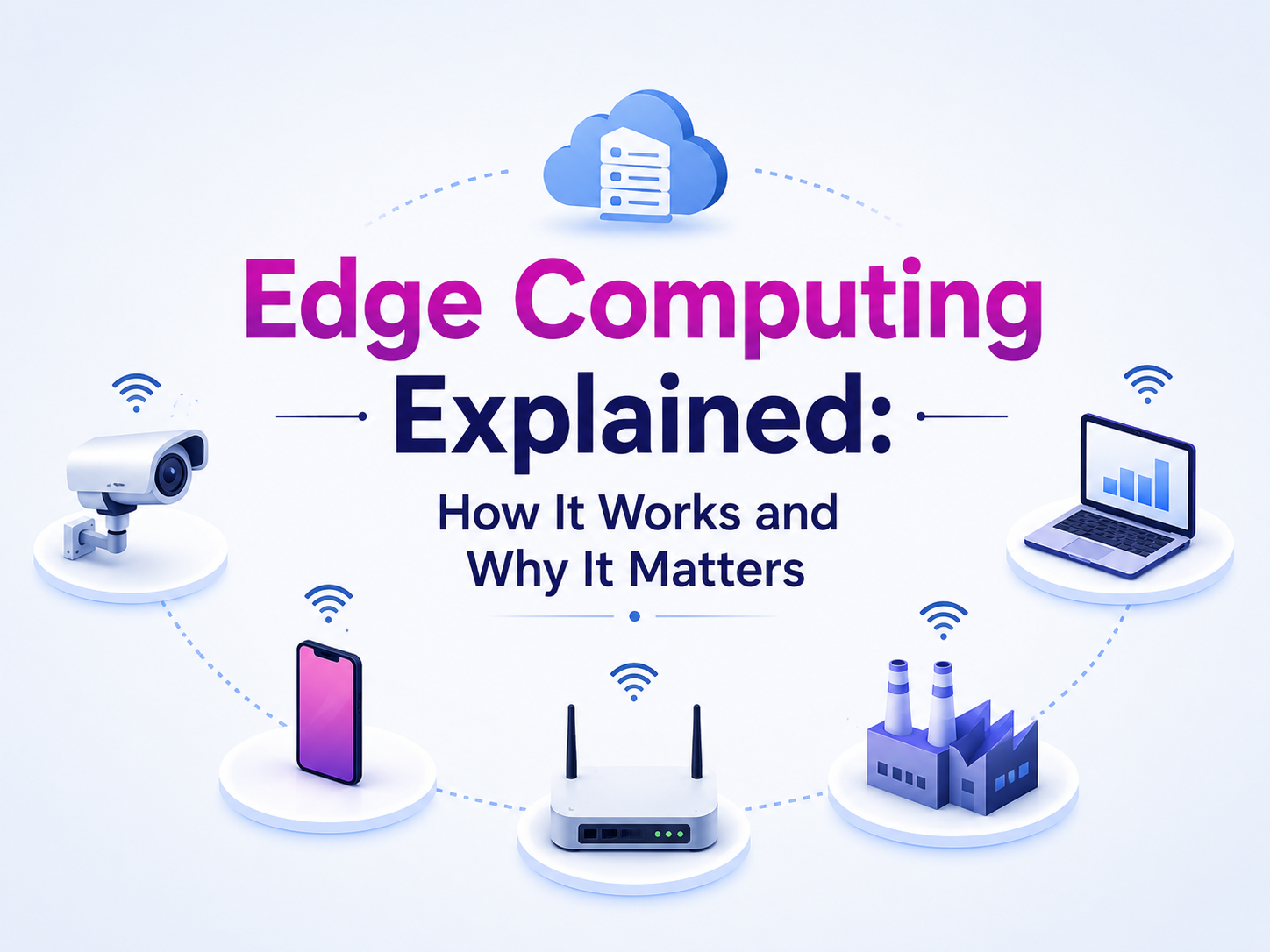
Massive volumes of data are produced every second by billions of devices, including connected devices, smart cameras, smartphones and sensors. Delays may result from sending all of this data to distant cloud servers, particularly for applications that require quick answers. This issue is resolved by edge computing, which enables quicker, more intelligent and more dependable decision-making by processing data closer to the point of creation. You will discover what edge computing is, how it operates, its benefits, challenges and practical uses in this guide.
Table of Contents
What is Edge Computing?
Instead of transferring all data to a centralized cloud or data center, edge computing processes data close to the point of generation. The term “edge” describes a network’s edge, where gadgets like wearable technology, cellphones, cameras, Internet of Things sensors and manufacturing machinery gather data. Edge computing lowers delay, conserves bandwidth and permits real-time decision-making by processing data closer to these devices.
Example
Consider a self-driving car.
In the absence of edge computing, the vehicle transmits sensor and camera data to a cloud server, waits for a response and then determines whether to use the brakes. Here, the car uses “edge computing” to process data and respond practically quickly. Passenger safety can be increased and accidents can be avoided with this quick response.
Why is Edge Computing Important?
Every day, massive volumes of data are produced by modern technologies including the Internet of Things (IoT), artificial intelligence (AI), 5G and smart devices. Delays and increased network traffic may result from sending all of this data to the cloud.
By processing data locally, edge computing solves these issues and improves the speed, dependability and efficiency of applications.
Among the primary perks are:
- Permits processing data in real time.
- Lowers delay to enable quicker reactions.
- Conserves bandwidth over the internet.
- Increases dependability when network connectivity is low.
- Improves privacy by handling private information locally.
Hoe Does Edge Computing Work?
Edge computing processes a large portion of the data close to the source rather than transferring it all to a remote cloud server. For storage and further analysis, only relevant or simplified data is sent to the cloud.
Step 1: Generation of Data
An IoT sensor, wearable technology, smart camera or self-driving car are examples of devices that gather data from their environment.
Step 2: Local Processing
Instead of being routed straight to the cloud, the data is processed by a nearby edge device or edge server.
Step 3: Quick Decision
The edge device reacts rapidly if quick action is needed.
For Example,
- Suspicious movement is detected by a smart camera.
- A potential issue is detected by an industrial machine.
- The brakes are applied by a self-driving vehicle.
- Traffic flow is adjusted by a traffic signal.
Step 4: The Cloud Receives Important Data
For long-term storage, advanced analytics, AI model training, backups and reporting, only relevant or simplified information is sent to the cloud.
Components of Edge Computing
- Edge Devices
These are gadgets that produce or handle data at the network’s edge.
Examples consist of:
- IoT sensors
- Smart cameras
- Smartphones
- Wearable technology
- Self-driving cars
- Smart home appliances
- Edge Servers
Small computer systems placed near customers or devices are known as edge servers. They reduce the requirement for communication with remote cloud servers by processing data locally.
- Cloud Data Centers
Large-scale data storage, advanced analytics, AI model training and backup creation are all handled by cloud data centers.
Benefits of Edge Computing
- Offers minimal delay and quicker response times.
- Minimizes bandwidth consumption by only transmitting necessary data to the cloud.
- Increases dependability even in situations with poor internet access.
- Improves privacy by handling private information locally.
- Supports IoT and real-time AI applications.
- Lowers the cost of cloud computing in a variety of situations.
- Improves the user experience for apps that are sensitive to delay.
Challenges of Edge Computing
- It can be challenging to manage thousands of edge devices.
- When compared to cloud servers, edge devices frequently have less processing capability.
- It is more challenging to secure several dispersed locations than a centralized data center.
- Installing edge infrastructure could cost a lot of money.
- It can be difficult to maintain and update software across multiple devices.
Real-World Applications of Edge Computing
- Retail: Edge computing is used in inventory management systems, smart shelves and e-commerce stores to improve customer service.
- Autonomous Vehicles: In order to make split-second driving judgements, self-driving cars locally evaluate camera and sensor data.
- Smart Cities: Edge computing is used in public infrastructure, traffic lights and security cameras to improve public safety and traffic control.
- Industrial IoT: Real-time equipment monitoring helps factories identify problems and minimize downtime through predictive maintenance.
- Video Surveillance: Without uploading each video frame to the cloud, AI-powered security cameras examine footage locally to find unusual activities.
- AR/VR and Games: As edge computing reduces delay, augmented and virtual reality experiences are more realistic and gaming is more dynamic.
Edge Computing and Cloud Computing: Working Together
Cloud computing is not replaced by edge computing. Rather, the two technologies work well together.
While the cloud offers large-scale storage, powerful analytics, machine learning model training and centralized management, the edge manages jobs that call for quick reactions. When combined, they produce digital systems that are quicker, more intelligent and more effective.
Conclusion
Processing everything in remote cloud servers is no longer always possible as linked devices continue to produce more data than ever before. By bringing intelligence closer to the source, edge computing enables quicker reactions, fewer delays and more effective use of network resources. The future of AI, IoT, 5G, smart cities and other real-time digital innovations will be powered by it when combined with cloud computing.
FAQs
- What distinguishes cloud computing from edge computing?
While cloud computing offers centralized storage, analytics and massive processing capacity, edge computing processes data close to the source for quicker replies.
- Is edge computing safe?
By processing sensitive data locally rather than sending it all to the cloud, edge computing may improve data privacy. However, strong cybersecurity measures are needed to secure numerous edge devices and locations.
- What is an edge device?
Any device that gathers, processes or analyses data close to its source is considered an edge device. IoT sensors, smart cameras, routers, gateways and connected cars are a few examples.
- Is an internet connection necessary for edge computing?
Not all the time. Without a continuous internet connection, a lot of edge devices may analyze data locally. However, in order to synchronize data with cloud services when necessary, internet connectivity is typically required.
Read More:
- What Is Cloud Computing? How It Works, Types, Benefits & Examples
- What Is an API? How APIs Work and Why They Matter
- What is OCR? How Optical Character Recognition Works & Its Applications
- AI in Finance: How Artificial Intelligence Is Transforming Financial Services
- What Is Cyber Security? Types, Threats and Best Practices