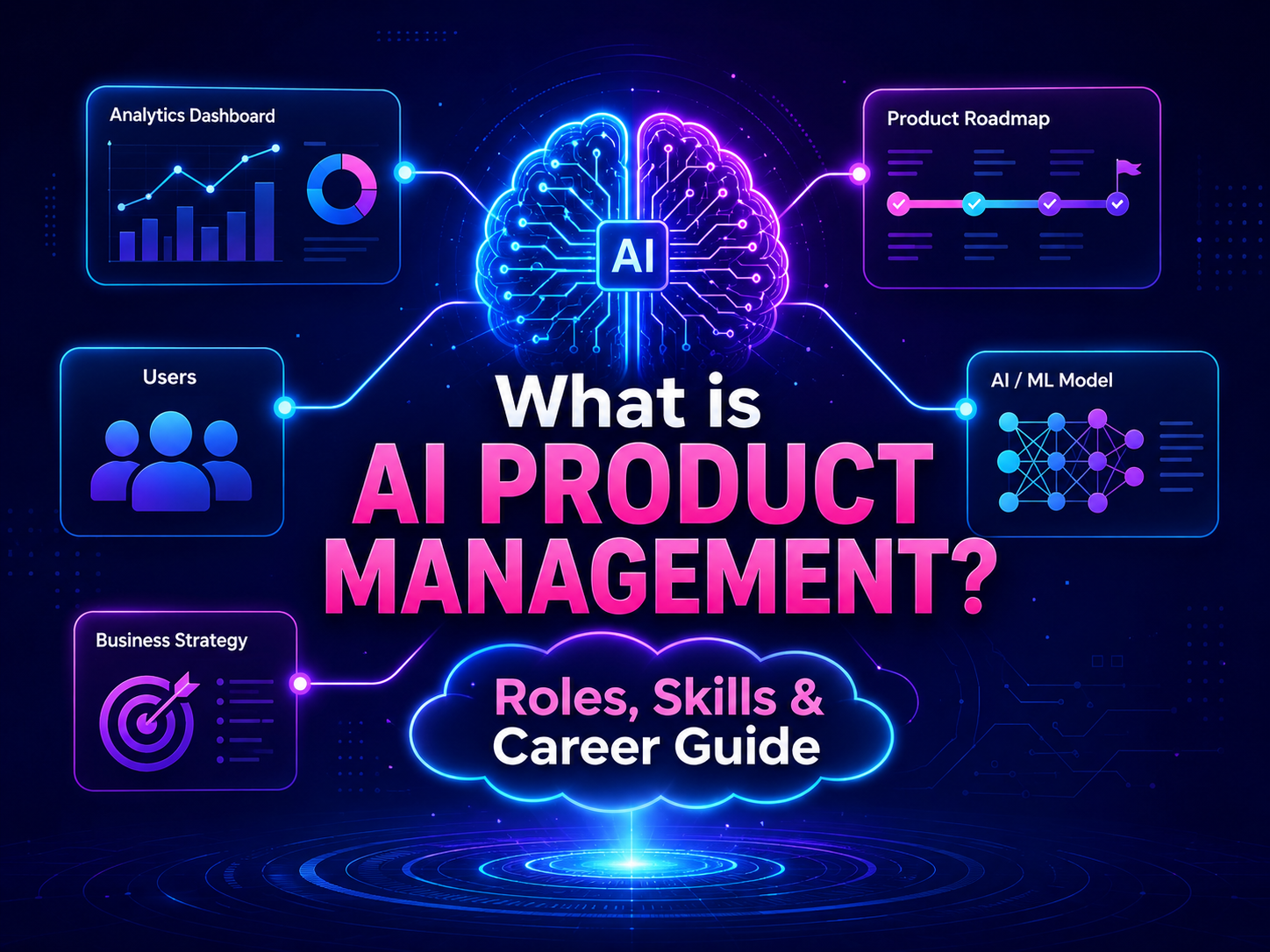
Artificial intelligence is no longer limited to research labs, it is being used in everyday products like chatbots, recommendation systems, smart assistants and fraud detection technologies. These intelligent products are the result of a systematic strategy that guarantees AI provides organizations and people with genuine value. This procedure is called AI Product Management, a quickly expanding field that blends technology, customer-focused decision-making and product planning.
What is AI Product Management?
The process of designing, creating, releasing and constantly improving products utilizing machine learning (ML) and artificial intelligence (AI) technology is known as AI product management. The purpose is to create intelligent products that meet company goals and address customer issues.
AI product management, as opposed to traditional product management, involves close collaboration among data scientists, machine learning engineers, software developers, designers and business stakeholders. AI Product Managers must also understand how data quality, model performance and user input affect the product since AI systems learn from data rather than according to predetermined rules.
An AI product manager typically serves as a bridge between business and technology rather than creating AI models. They focus on areas where AI can provide value, specify product specifications, rank features and guarantee that the finished product provides customers with significant outcomes.
Roles and Responsibilities of an AI Product Manager
- Recognizing Customer Issues
Finding actual business or customer issues that AI can resolve is the first duty. AI Product Managers assess whether AI is the best option because not all issues call for AI.
- Establishing the Vision and Strategy of the Product
They set the objectives, target market, success measures and long-term strategy for the product. This guarantees that the AI solution is in line with the business objectives of the company.
- Working Together with Cross-Functional Teams
Product managers for AI collaborate closely with data scientists, machine learning engineers, software developers, UX/UI designers, business stakeholders and marketing and sales teams, making sure that everyone is working toward the same product objectives and that technical choices are made with the needs of the customer in mind.
- Monitoring Data and AI Development
AI Product Managers assist in defining data requirements and guarantee that teams have access to high-quality, appropriate and responsibly sourced data because AI models depend on data. They also take part in conversations over explainability, accuracy, fairness and model performance.
- Setting Feature Priorities and Tracking Results
They manage development roadmaps, plan product releases and prioritize features just like traditional product managers. To develop the product over time, they regularly track key performance indicators (KPIs), customer input and AI model performance after launch.
Key Skills Required for AI Product Management
- Product Management Skills
Effective management of AI products requires a solid grasp of requirement gathering, Agile techniques, roadmap planning, product lifecycle management and feature prioritization.
- Data Literacy
AI Product Managers should be knowledgeable with data collection, processing and evaluation since AI systems rely on data. They can analyze product success and identify areas for improvement because they are familiar with analytics, data visualization and performance measurements.
- Strategic and Business Thinking
AI product managers may create solutions that are both technically possible and profitable by having a thorough understanding of market trends, customer behavior, competitive analysis and return on investment (ROI).
- Leadership and Communication
Coordinating cross-functional teams and interacting with stakeholders take up a significant portion of the work for AI product managers. Thus, maintaining project alignment and effectively resolving issues require strong communication, decision-making, negotiating and leadership abilities.
- Knowledge of AI and Machine Learning
AI Product Managers should be familiar with fundamental AI principles including machine learning, deep learning, natural language processing (NLP), computer vision, generative AI and large language models (LLMs), even though they are not required to create machine learning models themselves.
How to Become an AI Product Manager?
- Discover the principles of product management, such as user research, Agile, Scrum and product roadmaps.
- Gain a fundamental grasp of data science, machine learning, generative AI and artificial intelligence.
- Get experience working on AI or software-related projects, either on a personal or professional basis.
- Develop your communication, business and analytical abilities to work well with both technical and non-technical teams.
- Discover well-known technologies for product management and teamwork, including analytics platforms, Jira, Confluence and Notion.
- Create a portfolio that includes product strategy documents, AI project ideas and product case studies.
- Keep updated with the most recent developments in AI, such as large language models, multimodal AI, AI agents and responsible AI.
- To improve your resume, think about obtaining credentials in cloud computing, AI, product management or Agile approaches.
- Many AI Product Managers have backgrounds in computer science, information technology, engineering, business administration or data science, yet there isn’t a single educational path. Professionals from different professions can, however, also pursue this career by understanding the principles of AI, honing their product management skills and obtaining real-world experience through projects and certifications.
Career Opportunities and Future Scope
As businesses continue to use AI across the industries, the need for AI Product Managers has grown significantly. Professionals that can effectively manage AI-powered products are in high demand from businesses in the fields of healthcare, finance, e-commerce, education, manufacturing, cybersecurity, automotive, logistics and enterprise software.
Roles like Associate Product Manager, Product Manager, AI Product Manager, Senior AI Product Manager, Principal Product Manager, Director of Product Management and Chief Product Officer (CPO) are examples of great career milestones.
The future of AI Product Management looks promising. Companies will require professionals who know how to balance innovation with ethical AI practices, regulatory compliance and customer trust as technologies like generative AI, AI agents, multimodal AI and edge AI continue to evolve. AI product managers will have great long-term job possibilities if they consistently advance their technological knowledge and expertise in business.
Conclusion
AI product management is more than just managing AI technology. It’s about developing products that address important issues while striking a balance between user requirements, corporate objectives and technological potential. Professionals that are knowledgeable in both product management and AI will be crucial in creating the next wave of intelligent solutions as AI continues to transform industries. A fulfilling career in this developing profession can be attained by developing the proper combination of technical awareness, strategic thinking and teamwork abilities.
Read More:
- What is Retrieval-Augmented Generation (RAG)? How It Makes AI More Accurate
- What Is Fine-Tuning in AI? How AI Models Learn Specialized Tasks
- What Is Multimodal AI? How AI Understands Text, Images, and Audio
- What Are Large Language Models (LLMs) and How Do They Work?
- What Are AI Agents? How Autonomous AI Systems Work