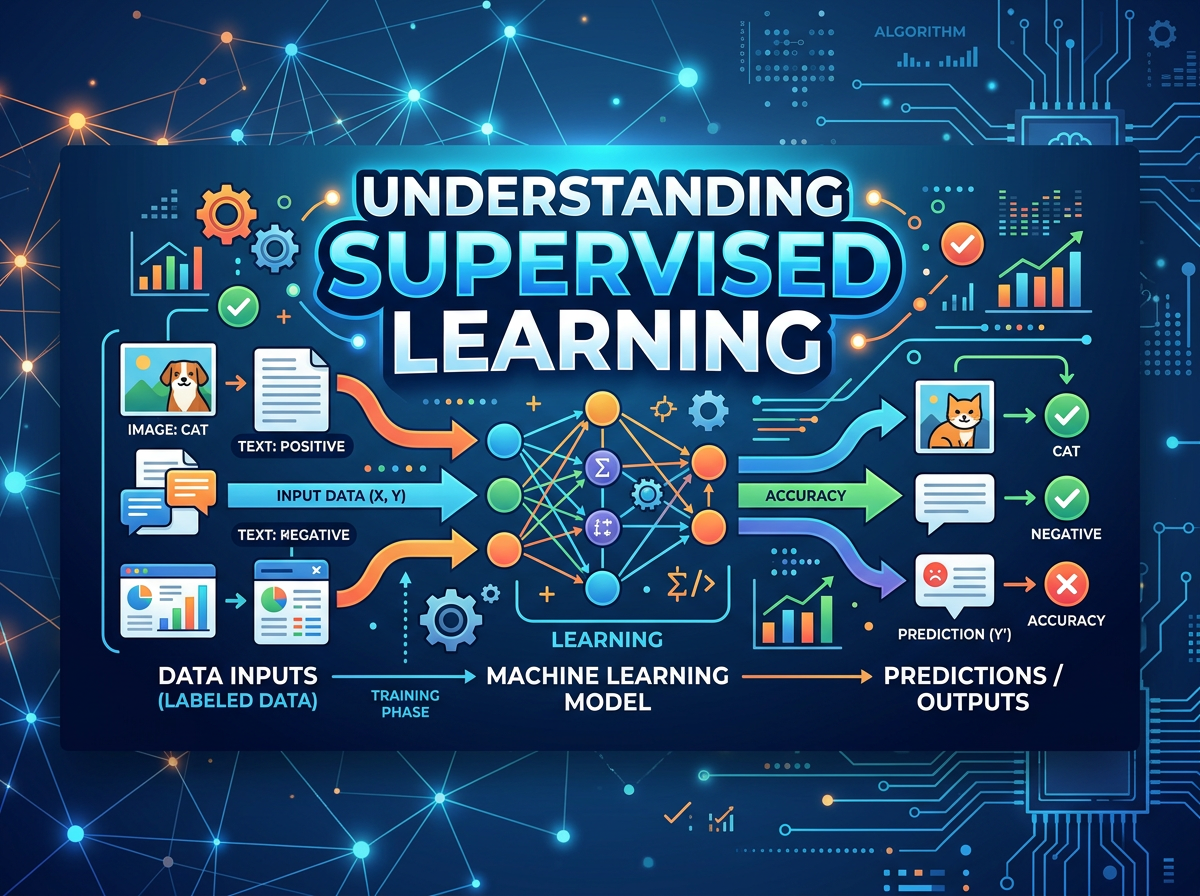
One of the most popular forms of machine learning is supervised learning. It enables computers to learn from labelled data in order to make exact predictions or decisions. Applications including fraud detection, image recognition, weather forecasting, recommendation systems and email spam detection often use it. It is important for the growth of modern artificial intelligence systems.
Table of Contents
What is the Supervised Learning?
Supervised learning is a machine learning method that uses labelled training data to teach a model. The term “supervised” refers to the fact that the system is trained using pre-supplied correct answers.
In supervised learning:
- The machine receives input data.
- Additionally, the appropriate output or label is supplied.
- The relationship between input and output is learned by the model.
- It estimates results for fresh, unidentified data after training.
For example, a model can learn traits like ear shape, body size, fur texture and face shape if it is trained using pictures of cats and dogs and their accurate labelling. When a new view is presented after enough training, the model examines these traits and determines if it shows a dog or a cat.

How Supervised Learning Works?
The following steps are often involved in the supervised learning process:
- Gathering Information
Large volumes of labelled data are gathered. Every data sample includes both the right output and input data.
- Preparing Data
After being cleaned and arranged, the gathered data is separated into training and testing datasets.
- Training Models
The machine learning algorithm looks for patterns between inputs and outputs by examining the training data.
- Model Testing
Unseen data is used to test the trained model’s performance and accuracy.
- Prediction
The model may predict results for fresh data once it has been effectively trained.
Types of Supervised Learning
There are primarily two types of supervised learning:
- Classification
When the output falls into one of the predetermined categories or classes, classification is applied.
For example:
- Identification of spam and non-spam emails
- Diagnosis of diseases
- Identification of faces
- Assessment of sentiment
For example, thousands of emails that have already been classified as “spam” or “not spam” are used to train the machine for email spam detection. Patterns like doubtful words, connections, sender details and email structure are all examined by the model. Following training, the system evaluates each new email and determines if it is spam or an authentic email.
- Regression
When the result is a constant numerical value, regression is being used.
For example:
- Predicting the weather
- Forecast for home prices
- Research of the stock market and sales forecasting
For example, information on a house’s size, location, number of rooms and past selling prices are used to train a house price prediction model. The model gains insight into how these variables impact property value. It can calculate the cost of a new home depending on the features after training.
Common Algorithms used in Supervised Learning
- Linear Regression
Continuous numerical values can be predicted using linear regression. It uses a straight-line equation to determine the link between input variables and output values. Trend evaluation, sales forecasting, and price prediction all frequently use this technique.
- Regression Logistic
The primary application of logistic regression is in classification situations where the output is classified. It estimates the chance that something will happen, such whether or not an email is spam. For binary classification jobs, it is straightforward, quick, and efficient.
- The Decision Tree
A decision tree divides data into branches according to conditions like we see in flowchart. By examining various potential outcomes, it assists in decision-making. As it is simple to learn and apply, this method is extensively used.
- Random Forest
Several decision trees are combined in the complex Random Forest method to increase prediction accuracy. It uses the average output from several trees rather than just one. It works well with big datasets and lessens excessive fitting.
- SVM or support vector machines
Regression and classification tasks are both handled by Support Vector Machines. It functions by determining the optimal boundary between various data classes. SVM is very good at pattern identification, text classification and image recognition.
Benefits of Supervised Learning
- High Accuracy: Predictions are typically accurate because the model learns from labelled data.
- Simple Performance Evaluation: Measuring model performance is made simpler by the availability of accurate outputs.
- Beneficial for Real-World Applications: It is highly used in cybersecurity, finance, healthcare and e-commerce.
- Predictive Capability: These models are capable of correctly predicting future events.
Drawbacks of Supervised Learning
- Needs Large Labelled Datasets: It can be costly and time-consuming to prepare labelled data.
- Training Takes Time: Long training times and a lot of processing power may be needed for complex models.
- Overfitting Risk: Sometimes, the model learns broad patterns by repetition of training data.
- Limited Flexibility: The model’s performance is limited to the tasks for which it was trained.
Applications of Supervised Learning
- Detection of Email Spam: By examining trends, keywords, and sender details from previously labelled emails, supervised learning assists in the identification of spam emails.
- Health Diagnosis: It is used in healthcare to properly evaluate medical reports or photos and identify disorders.
- Identification of Images: Systems can identify faces, objects, handwriting, and other visual components in pictures thanks to supervised learning.
- Fraud Identification: Supervised learning is used by banks and other financial institutions to identify suspicious transactions and stop internet fraud.
Conclusion
Healthcare, finance, education, e-commerce and cybersecurity are just a few of the areas that benefit from supervised learning’s widespread application in classification and regression problems. Many real-world issues are effectively resolved by supervised learning using algorithms like SVM, Random Forest, Decision Trees and Linear Regression. Students, data analysts, AI experts, software developers and anybody interested in modern technology and artificial intelligence should all grasp supervised learning.
FAQs
- In supervised learning, what is labelled data?
Both the input data and the right output or response are included in labelled data.
- What distinguishes supervised learning from unsupervised learning?
Unsupervised learning uses unlabelled data, whereas supervised learning uses labelled data.
- Is supervised learning a part of artificial intelligence?
Yes, supervised learning is a significant part of artificial intelligence and machine learning.
- Who should study supervised learning?
For understanding current AI technology, students, AI users, data scientists and software developers need to study supervised learning.
- What is overfitting in supervised learning?
When a model memorizes training data rather than discovering broad trends, it is said to be overfitting.
Read More
- Introduction to Machine Learning
- What is Unsupervised Learning? Types, Benefits and Applications
- What is Data Annotation? Importance, Types, Tools & Platforms and Challenges
- Types of Data Annotation Explained with Examples
- Difference between Supervised Learning and Unsupervised Learning