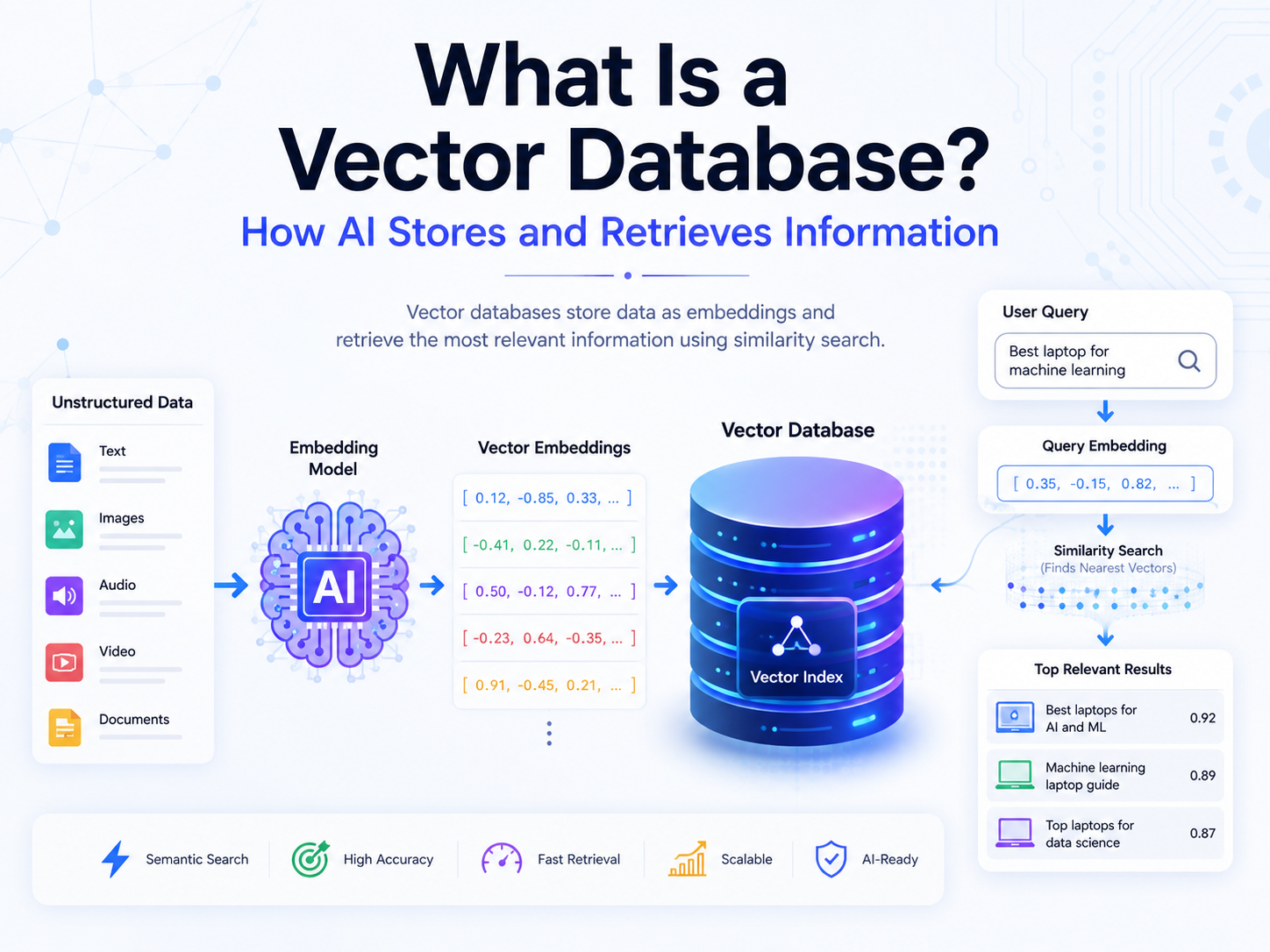
Every day massive volumes of text, photos, audio and other unstructured data are produced and processed by modern AI systems. Instead of only matching keywords, AI needs to be able to understand the meaning of the fundamental information in order to provide accurate results fast. Vector databases are vital in this situation. They make it possible for AI systems to conduct intelligent searches, increasing the speed and accuracy of programs like chatbots, recommendation engines and semantic search.
What is a Vector Database?
Vector embeddings, which are numerical representations of data produced by AI models, are stored, managed and searched in vector databases. A vector database finds material that is semantically comparable to a user’s query rather than looking for specific words or phrases.
Vector databases compare the mathematical relationships between vectors, in contrast to standard databases that depend on exact matching. This makes it possible for AI programs to understand the context and meaning of data, producing more accurate and relevant search results.
What are Vector Embeddings?
Numerical representations of data including text, photos, music and videos are called vector embeddings. Data is transformed into vectors with hundreds or even thousands of numerical values by AI algorithms called embedding models.
The original data’s semantic meaning is captured by these vectors. In a multidimensional vector space, items with comparable meanings have vectors that are near to one another. For example, although being distinct words, the terms “car” and “automobile” produce comparable vector embeddings due to their very identical meanings.
Why do AI Systems Need Vector Databases?
Large volumes of unstructured data that cannot be effectively searched using conventional databases are processed by modern AI technologies. Conventional databases are appropriate for structured data such as transaction or customer records because they are made to retrieve records based on exact values.
However, rather than finding identical information, AI systems frequently need to locate similar conceptually information. When a user searches for “ways to reduce electricity bills,” for example, an AI system need to find information about energy conservation or lowering power use even if those specific terms aren’t used.
By conducting semantic searches, vector databases enable AI applications to provide quicker, more appropriate and context-aware responses.
How does a Vector Database Work?
The process starts when an embedding model is used to transform data like documents, pictures or product descriptions into vector embeddings.
After being saved in a vector database, these embeddings are arranged for effective searching using specialized indexing algorithms. The same embedding methodology is also used to transform user-submitted queries into vector embeddings.
The vector database finds the closest matches based on similarity by comparing the query vector with the stored vectors. The AI program then receives the most important data and uses it to produce accurate and relevant responses.
Key Features of Vector Databases
- Semantic Search: Vector databases increase search relevance by using meaning rather than exact terms.
- Similarity Search: They enable extremely accurate information retrieval by identifying vectors that are mathematically closest to a query.
- Fast Vector Indexing: Millions of vectors can be swiftly and efficiently searched due to sophisticated indexing techniques.
- Scalability: Large datasets can be effectively managed by vector databases without compromising search performance.
- Quick Retrieval: They are appropriate for interactive AI applications like chatbots and virtual assistants because they respond quickly.
- Filtering Metadata: Metadata like categories, dates or user information can be used to narrow searches in addition to vector similarity.
Benefits of Vector Databases
- Quicker Access to Information: To locate the most relevant findings, they swiftly scan through huge databases of embeddings.
- Improved Search Accuracy: Even when various terms or phrases are used, semantic search assists users in locating relevant material.
- Improves AI Reactions: AI models respond more accurately and informatively when they are given relevant context.
- Manages Unstructured Information: Text, photos, audio, videos and other unstructured data formats are all effectively managed by vector databases.
- Adapts to Big Datasets: Millions or even billions of vector embeddings can be stored and searched by them.
- Supports AI Applications in Real Time: They are perfect for applications that need quick replies because of their quick retrieval capabilities.
Applications of Vector Databases
- Retrieval-Augmented Generation (RAG): Enhances AI-generated replies by retrieving relevant documents.
- AI virtual assistants and chatbots: Use knowledge bases to provide accurate responses.
- Semantic Search Engines: Uses meaning instead of terms to deliver search results.
- Recommendation Systems: Based on user preferences, make recommendations for goods, films, music or other material.
- Image and Video Search: Use embeddings to locate visually related photos or videos.
- Enterprise Knowledge Bases and Document Search: Assist organizations in finding relevant information and documents fast.
- Fraud Detection: Use behavioral similarities to spot odd transaction patterns.
- Healthcare and Biomedical AI: Use research papers and medical records to help in diagnosis and decision-making.
Popular Vector Database Tools
- Designed for scalable AI applications, Pinecone is a fully managed cloud-based vector database.
- Large-scale similarity searches are handled using the open-source vector database Milvus.
- For AI-powered applications, Weaviate integrates knowledge graph capabilities with vector search.
- An open-source vector database called Chroma is often used in RAG and LLM projects.
- High-performance vector search with sophisticated filtering features is the main focus of Qdrant.
- In addition to its standard search features, Elasticsearch offers vector search.
Challenges of Vector Databases
- Excessive Storage Needs: A significant amount of storage space may be needed for a large number of vector embeddings.
- Complicated Index Administration: As databases expand, maintaining quick search speed requires effective indexing.
- Expensive on a Big Scale: It might need a lot of infrastructure and processing power to manage billions of vectors.
- Results Are Affected by Embedding Quality: The quality of the embedding model adopted has a significant impact on the accuracy of search results.
- Data Updates May Be Difficult: Careful maintenance is needed to keep embeddings in line with constantly changing data.
Best Practices for using Vector Databases
- To produce accurate vector representations, use a high-quality embedding model.
- Choose an indexing technique that strikes a balance between accuracy and speed.
- To improve filtering, save metadata next to vector embeddings.
- Every time the fundamental data changes, update the embeddings.
- Adjust the similarity search parameters according to the needs of your application.
- As datasets expand, keep an eye on database performance and scale infrastructure.
Conclusion
By allowing searches based on context and meaning rather than exact matches, vector databases have revolutionized the way AI stores and retrieves data. They are a crucial part of many current AI applications because of their capacity to effectively manage massive amounts of unstructured data. Vector databases will continue to be a crucial technology for creating quicker, more intelligent and more dependable AI solutions as intelligent systems develop.
Read More:
- What is Retrieval-Augmented Generation (RAG)? How It Makes AI More Accurate
- What Is Fine-Tuning in AI? How AI Models Learn Specialized Tasks
- What is AI Inference? How AI Models Make Predictions
- What Is Multimodal AI? How AI Understands Text, Images, and Audio
- What is OCR? How Optical Character Recognition Works & Its Applications